This article was first published in Volume 1, Issue 4 of the Owensboro Times newspaper.
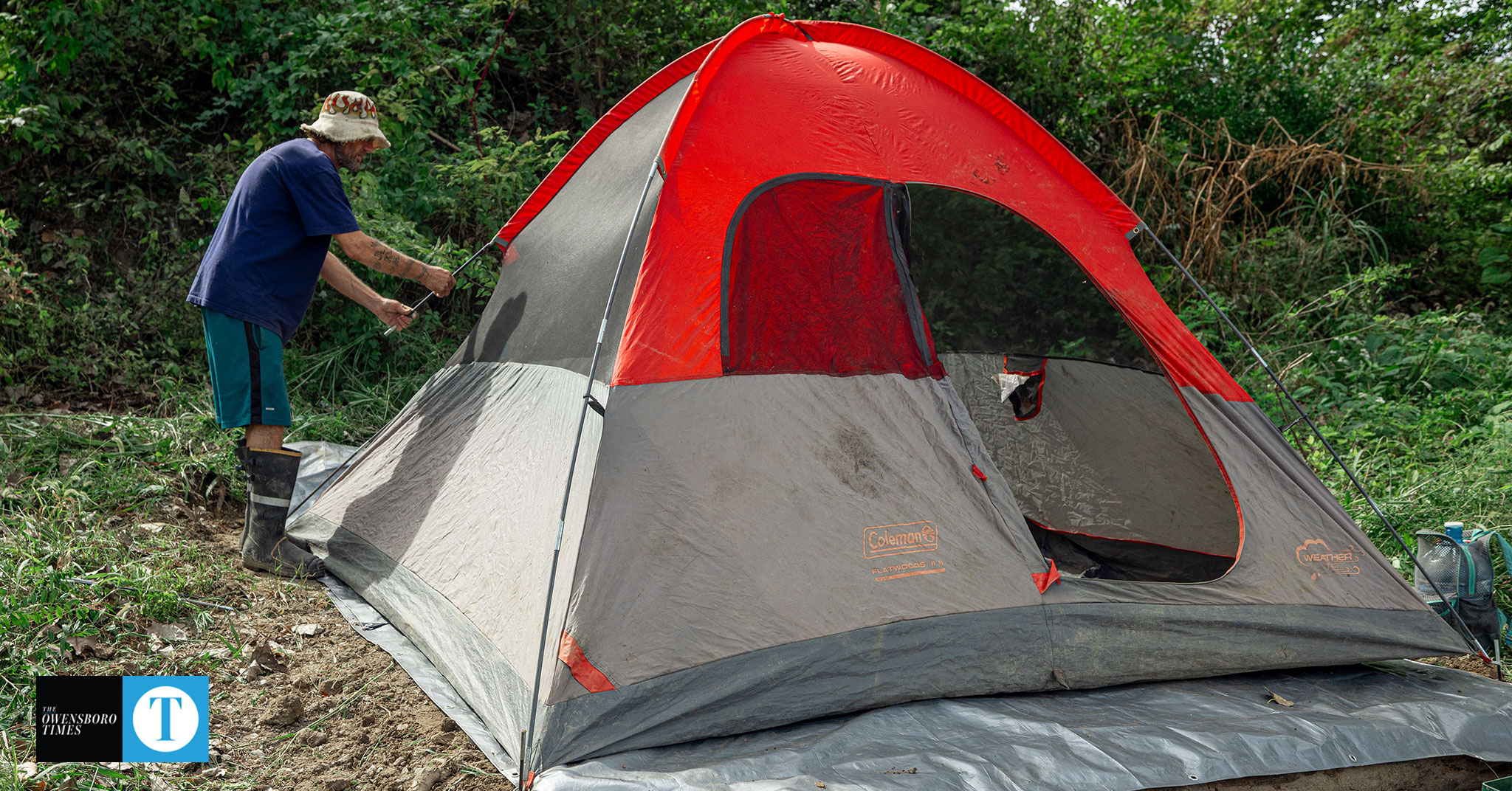
“I just wish people would give us a chance,” Radar said, tugging at the corner of his tent.
At Tent City along the Ohio River, individuals who are homeless said the public sees their tents but not their stories — ones of personal loss, stalled recovery, and the daily work of survival.
They know how Owensboro talks about them. They’ve heard the rumors about addiction, crime, and outsiders. Yet in interviews, they repeated the same plea: Don’t judge the book by its cover. Open the book and read.
A narrow footpath cuts through scrub trees to the clearing they call Tent City. A shallow creek marks a boundary that residents said they use to determine where tents can go. Cleared paths run between campsites. Evidence of resourcefulness is everywhere — salvaged pallets for platforms, tarps stitched into vestibules, makeshift racks for drying clothes after a rain.
On a bright fall afternoon, one person tightened the guy lines on a sagging shelter. Two men cast fishing lines into the river. A woman knelt with thread and stones, turning bits of river rock into handmade jewelry. A few people slept. Others talked in the open, dogs curled at their feet.
The scenes were ordinary and human — and that was the point, they said. They know the public debate about homelessness is loud and constant, with strong opinions about root causes and quick fixes. They also know that life there is more complicated than a slogan.
Many said they do not want to be here. Many also said they have not found a steady path out.
“There are some who may have issues like addiction and things like that, but some don’t,” said Rudy, who said he once painted for a living and took home $850 to $900 a week. “Some just get away from everybody because they can’t keep their bills, because they don’t make enough money. … My mom died, and I haven’t got back up. It’s been like three years.”
Rudy said progress starts with one thing.
“Housing is housing,” he said. “The key — just housing.”
Sean said he ended up in the camp after being “screwed over” in a deal involving his home and trailer, then bouncing between relatives.
“It’s hard to get a job when you’re homeless,” Sean said. “I go to God, and church tells me to help people. I try to help people, too.”
Betty, 42, said she grew up in Owensboro and came to Tent City this summer after a housing arrangement fell through.
“We were paying rent, and they (roommates) didn’t pay the rent, so we got kicked out,” Betty said. “I can’t get a job because I’m homeless … It’s kind of hard to get a job when you don’t have any way of bathing or getting clean clothes.”
She said losing her son in a recent crash and caring for her boyfriend through brain cancer made the past few months harder. She keeps a miniature Chihuahua — her “baby” — with her and said that rules or limited space keep her out of some shelters.
“I have tried some shelters a couple times … and I couldn’t get in because they didn’t have any spots left,” she said.
Residents described a fragile but persistent sense of community — people sharing food, pointing newcomers to a safe spot, splitting wood, trading rides, watching each other’s dogs.
“We don’t have much, but we’ll share what we got,” Betty said.
Several said they had been locked out of nearby facilities and restrooms. That has meant hauling water from farther away and improvising ways to keep phones charged long enough to coordinate appointments for services or jobs.
“People help you out,” Betty said. “Some people … will see you walking with a jug, and they’ll be like, ‘Hey, let me fill it up for you.’”
Radar said he has been in the wooded area for 8 years. He described Tent City as a place that is quieter than outsiders imagine, with its own rhythms and norms.
“It’s a lifestyle,” Radar said. “You get down here … go fishing anytime you want to. Good people down here. There’s this bad image about Tent City — thugs and all kinds of drugs. It’s not like that at all. There’s stuff down here, but it’s everywhere.”
Asked whether addiction contributes to homelessness, he said, “Addiction could be drinking too much coffee, smoking too many cigarettes, scratching too many [lottery] tickets. It’s rough down here.”
Stella, 50, said she has lived in several states and landed in Owensboro after a friend told her rentals might be available. That didn’t pan out, and she ended up in Tent City. There, she began making jewelry from river stones, metal, and fishing line she found along the shore. With her dog, Bob Marley, at her heels, she lifted a comb she was turning into a hairpiece.
“I just make pieces out of rocks,” Stella said. “When the church people seen it … they fell in love with it. They’re gonna show my jewelry.”
She described panhandling some days and catching blue catfish on others, wrapping fillets in foil and cooking them over a small campfire with seasoned salt and butter.
“Everybody kind of helps everybody else,” she said.
Nearly everyone interviewed said the majority of the people living along the river are from Owensboro. Residents estimated that three out of four are locals, if not more. They acknowledged that some arrive from out of town — including people who came for sober living or treatment — but said most are friends, relatives, or neighbors who ran out of options.
“Most of us down there are from here,” Betty said. “We’re making the best of a bad situation.”
Their accounts come as local leaders debate what to do. Some Owensboro residents argue that the local network of sober-living and recovery programs attracts people who later remain here when things go wrong. Others have pressed for tighter rules on group homes and stricter enforcement in parks. Several people living at the encampment said they feel those debates often happen without them.
“They think we’re down here so we’re idiots,” Rudy said. “We’re not.”
People at Tent City offered different ideas about what would help. Some pointed to basic documentation requirements as a barrier — getting an ID or Social Security card without transportation or a permanent address can stall everything from housing applications to jobs.
“A lot of us can’t get to [the] documentation that they want,” Betty said. “That’s a lot of the problem.”
Others said emergency shelter rules, long waits, and limited beds — especially for couples or people with pets — make it hard to transition off the riverbank.
Residents also described gaps between promises and delivery. Radar said he once completed paperwork that he was told would lead to a hotel room and supplies.
“I still ain’t got none of that,” he said.
Churches and local groups come by periodically, people said, with tents, food, and other supplies. Those gestures matter.
“We appreciate everything the community does,” Betty said. “Our tent got flooded out … just a little bit helps.”
Winter looms over every conversation. Some remembered cobbling together insulation in older tents. Others worried openly about their first season outdoors.
“I am very, very worried,” Betty said.
Throughout Tent City, dogs are constant companions — a source of comfort, and sometimes a barrier to services that won’t accept pets. Several said they feed their animals before themselves.
“We’re just people,” Radar said. “We’re not hurting nobody being down here… I just wish people would give us a chance.”
Whether homelessness is viewed as a problem depends on who is asked. Some residents point to rents and wages. Others say Tent City is its own community, where people help one another survive — and where outsiders see only what they expect.
“Housing is housing,” Rudy said again, matter-of-fact.
Betty added a coda she hopes readers will carry with them.
“Not all of us that are homeless are [drug] addicts,” she said. “Not all of us are people looking for a handout … Some of us are down here because we have to be.”
Radar summed it up:
“Don’t judge the book by its cover. Open the book up and read it. That’s the best way I can put it — short and simple. People look at us and think they know the story just by what they see, but you’ve got to open it up and see what’s really inside.”