This article was first published in Volume 1, Issue 4 of the Owensboro Times newspaper.
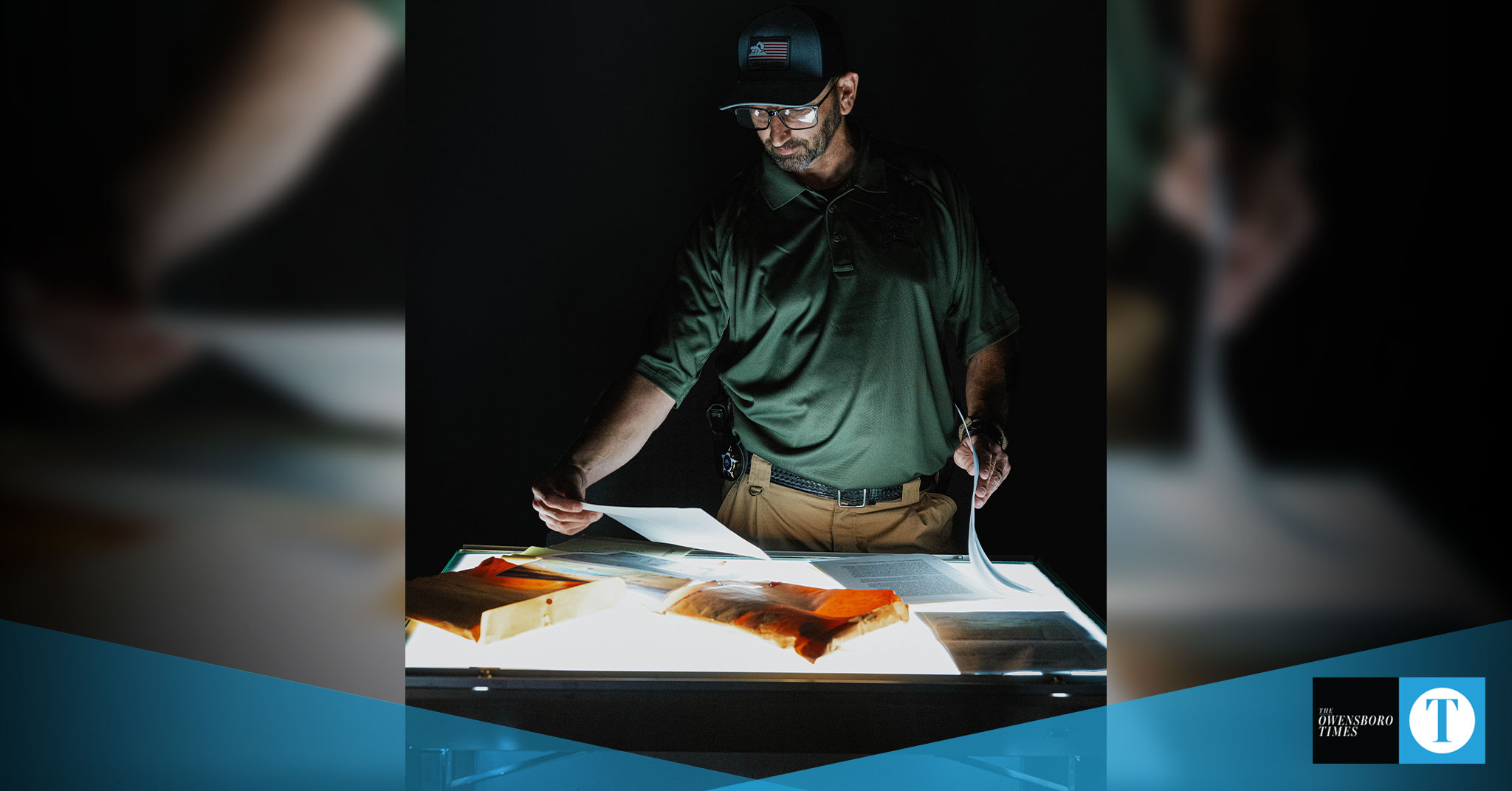
The Daviess County Sheriff’s Office is breathing new life into old cases. With the hiring of veteran investigator Mike O’Herron as its first cold case detective, the department is taking a fresh, focused approach to long-unsolved crimes — and making a renewed promise to families still waiting for answers.
Youngman said the move reflects both a strategic and moral decision.
“A lot of agencies claim their cases never go cold because they’re technically still assigned to someone,” Youngman said. “But the reality is, if you don’t have someone dedicated to actually looking into them, you’re not being proactive. You’re just being reactive. And the more time goes by, the less likely it is that anyone’s going to reach out with information.”
For Youngman, dedicating resources to old cases wasn’t about making headlines. It was about making good on promises. Behind every unsolved file, he said, is a family still waiting for justice.
“There are people out there who still know things,” he said. “We want to be able to get to them and speak with them before it’s too late.”
A detective who thrives on the puzzle
When Youngman began searching for the right person to lead the effort, he already had someone in mind. He needed a seasoned investigator who could balance persistence with patience, someone who could follow a trail of evidence that had long gone cold without losing focus or faith in the process. That person was Mike O’Herron, a former Owensboro Police Department detective known for his analytical mind and steady demeanor.
“I’ve known Mike for years,” Youngman said. “He’s one of those people who has the time management, the investigative instincts, and the drive to keep after something even when the answers aren’t easy. When he told me he’d be interested, I was thrilled.”
For O’Herron, the opportunity came at an unexpected time. After more than a decade in law enforcement — three of those as a detective — he’d stepped away in 2021 to pursue another passion: woodworking. The long hours and heavy caseloads had left him burned out, but he still felt a pull toward investigative work.
“I always liked the puzzle part of it,” O’Herron said. “The digging, the chess game of it all. Whether you’re talking to a witness or flipping over rocks to find that one missing piece, there’s always something there if you can just find it.”
Born and raised in Virginia, just outside Washington, D.C., O’Herron served six years in the Marine Corps before moving to Kentucky in 2009, the same year he joined the Henderson Police Department. Four years later, he transferred to OPD, where he met both Youngman and Captain Jeff Payne, who now oversees the Criminal Investigation Division at DCSO.
“Mike’s one of those guys who’s steady,” Payne said. “He’s analytical — he has to be, not just as a detective but as a woodworker, too. He thinks things through. He’s patient. When Brad said, ‘How about O’Herron?’ I said, ‘I think that’s a perfect fit.’”
Building a foundation before chasing leads
For now, the focus is on organization. Decades of evidence, reports, and recordings — often scattered or stored in outdated formats — must be reviewed and cataloged before any major breakthroughs can happen. Payne said the process has been revealing.
“We’ve been able to identify several cases that clearly qualify as cold cases,” Payne said. “But we know there are probably more. We’re going back through old files, old reports, even old evidence rooms. In some cases, we’re finding VHS tapes, micro cassettes, things we literally didn’t have equipment to play anymore.”
The department has begun digitizing those materials and modernizing how cases are archived, working with outside agencies to transfer aging evidence into accessible formats. O’Herron said his methodical approach and natural patience make him well-suited for that stage.
“You can read something and take it at face value,” he said. “Or you can dig in a little deeper, confirm or disprove it, and figure out what’s missing. It’s about following every thread, even if it seems small.”
That tenacity is what Youngman and Payne were counting on when they pushed to create the new role, one that Daviess County Fiscal Court helped fund earlier this year.
“It’s not fair to expect detectives who are juggling fresh cases every day to also dig into decades-old files,” Youngman said. “Every detective in this country is overworked. They’re buried in active cases. A cold case might be technically ‘assigned,’ but no one has time to really touch it. That’s why this position matters.”
Defining a “cold case” and what success looks like
When most people hear the term “cold case,” they think of unsolved murders. And while homicide investigations make up many of the files on O’Herron’s desk, the category is far broader than that.
“Somebody stole something out of my car in Louisville 15 years ago — technically, that’s a cold case,” Youngman said. “But the reality is, what we’re talking about here are serious, egregious crimes — murders, sexual assaults, missing persons. Those are the ones that can’t just be closed. They deserve to stay open until we’ve done everything we can.”
The sheriff said that commitment isn’t about statistics or press releases. It’s about integrity and the message it sends to the community.
“It’s not just in the interest of the victims’ families,” he said. “It’s in the interest of society. Because if someone murdered another person, and we don’t find out who it was, that person’s still out there. People need to know we’re doing everything we can — not just when it’s fresh, but always.”
As for what “success” looks like in such a role, Youngman said it can take many forms. Some cases might lead to an arrest. Others may simply reach a point where the department can confidently say they know what happened, even if the suspect is deceased and prosecution is impossible.
“If we can get to the point where we know, beyond a reasonable doubt, who’s responsible — even if we can’t take it to court — that’s still meaningful,” he said. “Because we can meet with the family, show them the evidence, and explain how we got there. That kind of closure can mean everything.”
For the sheriff, what matters most is movement — progress, no matter how small.
“The expectation isn’t that Mike’s going to solve every case,” Youngman said. “It’s that the cases are being worked. That they’re not just sitting in a box somewhere. We’re showing these families that we care enough to keep trying.”
The human side of the job
For O’Herron, the technical work is only half the challenge. The other half is human, reconnecting with families who’ve waited years for updates, and sometimes with witnesses who have moved on, aged, or buried the memories deep.
“These are sensitive conversations,” he said. “You can’t just show up and say, ‘Tell me what you remember.’ You have to understand that these people have lived with this for decades. Some of them have lost hope. So earning that trust again, that’s a big part of it.”
He knows he’ll be revisiting painful moments in people’s lives, but he said that’s what gives the work its purpose.
“You can’t measure success just by charges filed,” O’Herron said. “If I can go to a family and say, ‘Here’s what we know, here’s what we’ve done, and here’s what we’re still working on,’ that matters. Because at least they know someone’s still looking.”
Youngman echoed that sentiment, saying one of the department’s goals is to communicate more openly about ongoing efforts. Earlier this year, DCSO launched a section on its website highlighting unsolved cases, inviting the public to submit tips or memories that might help.
“We want people to see that we’re not letting these cases sit untouched,” Youngman said. “Even if it’s just one new lead, that might be all it takes to open a door that’s been closed for decades.”
The quiet work of persistence
For O’Herron, some mornings are spent combing through stacks of case files; others are dedicated to phone calls, requests for records, or quiet hours of analysis. Occasionally, he and other detectives head out to re-interview witnesses, sometimes the same people questioned 30 or 40 years ago.
“I don’t think people realize how much patience this kind of work takes,” O’Herron said. “You have to be okay with the slow burn. Some days you get nothing. Some days you find a note that changes everything.”
He doesn’t mind the solitude. His workshop — filled with sawdust, hand tools, and the steady hum of creation — has become a space where he can reflect and recharge.
“When I’m out there, it’s quiet; well, kind of noisy, but it’s mine,” he said, laughing. “That’s when I think. I’ll be working on a piece of wood, and my mind’s going back through something from a case. It’s weird how often that helps me see something differently.”
Youngman said that blend of discipline and reflection is exactly what makes O’Herron the right fit.
“He’s the kind of guy who’s going to keep turning it over in his head until something clicks,” the sheriff said. “That’s what these cases need, someone who won’t stop thinking about them.”
Looking forward
As O’Herron settles into the role, the Daviess County Sheriff’s Office continues to refine how it handles old cases, blending traditional detective work with modern technology and public collaboration. The department plans to keep adding to its online database and hopes residents will continue to come forward with tips, even about cases they think are long closed.
For Youngman, the creation of the cold case detective position marks more than just an internal reorganization. It’s a statement of values.
“These cases are important,” Youngman said. “If we can bring closure to even one family, or just show them that we still care, that’s what matters.”