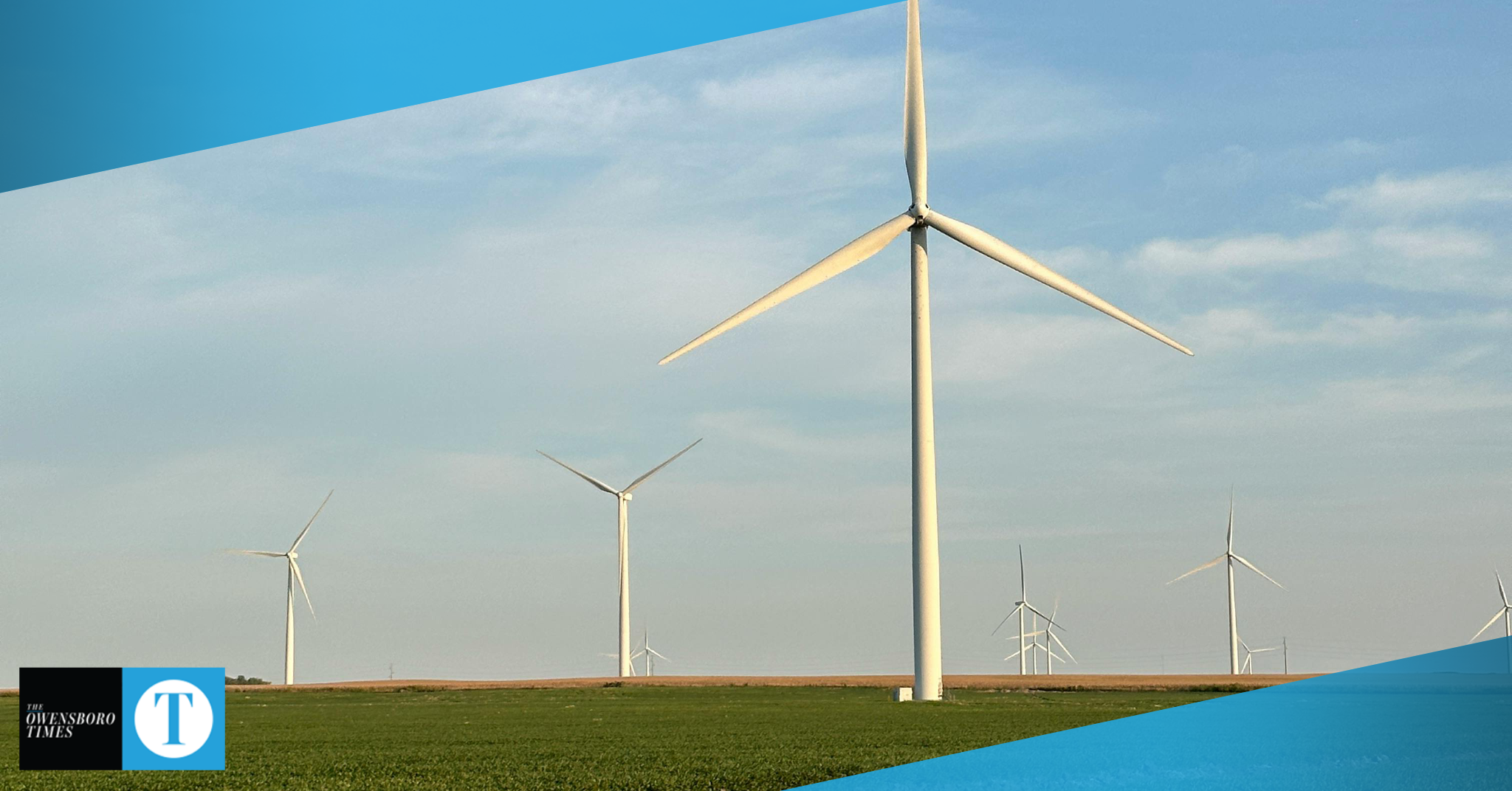
Daviess County Fiscal Court will consider a new moratorium on Thursday that would temporarily halt the acceptance and processing of applications related to battery energy storage systems and wind energy conversion systems while local officials study how the technologies should be regulated.
The proposed ordinance would prohibit the acceptance, review, processing, or approval of applications, permits, and requests tied to the construction, expansion, or establishment of battery energy storage systems (BESS) and wind energy conversion systems (WECS) in Daviess County through June 30, 2027.
Judge-Executive Charlie Castlen said the proposal is precautionary and not tied to any known applications currently pending in Daviess County.
“There are no actual applications that I know of,” Castlen said. “The fact that we don’t know anything about it — we being the local elected officials — is what, in my mind, makes it prudent for us to do a moratorium so that we and Planning and Zoning can educate ourselves as to what changes we might want to put in place that would be protective of our community.”
Castlen said concerns about a proposed wind energy project in neighboring Henderson County helped spark discussions about whether Daviess County should establish regulations before similar projects are proposed locally.
According to Castlen, Henderson County residents recently shared information with him about a proposed wind farm that could include 93 turbines near the Daviess County line.
“If they’re right across the river, they could easily want to do one on our side,” Castlen said.
The proposed ordinance states that the current Owensboro Metropolitan Zoning Ordinance and Comprehensive Plan do not specifically address battery storage or wind energy developments and that additional study may be needed to ensure such facilities are properly located and regulated.
If approved, Fiscal Court would direct the Owensboro Metropolitan Planning & Zoning Commission to study the impacts of battery storage and wind energy facilities on infrastructure, the environment, and land-use compatibility; evaluate appropriate zoning districts and performance standards; and prepare recommended regulations for consideration by Fiscal Court.
County Commissioner Larry Conder said he understands the reasoning behind the proposed moratorium but expressed concern about the growing number of development moratoriums currently in place and the length of time it has taken to establish regulations for some projects.
Conder said approval of this ordinance would essentially mean the county has five moratoriums in effect, noting ones already in place for solar energy facilities, data centers, and multi-unit transitional housing.
Conder said moratoriums can be useful because they allow local governments time to create rules and regulations, but he believes the process should include clearer timelines and greater transparency.
“When we place the moratoriums in effect, what that means to me is that as elected officials, we’re responsible for getting the rules and regulations changed,” Conder said. “We should tell the public, yes, the moratorium is in place, and by the way, we’re going to be working with this group or that group to get that done, and we think our time frame is about five months. Right now, we don’t really have that.”
While reserving judgment on future wind and battery projects, Conder noted that Daviess County currently does not produce any power.
“People need to remember that going forward,” he said. “What are we going to do about controlling our own destiny and producing power? I can understand why you don’t like solar farms or wind turbines or anything else, but right now we don’t produce anything.”
Commissioner Chris Castlen said the proposed moratorium is intended to give county officials time to learn more about emerging technologies before making long-term decisions.
“It’s more of the unknown,” he said. “The decisions we make now can and will affect what happens in the community for generations to come. Without knowing more about something that’s fairly new, we don’t want to make any missteps and create an issue for the community that we could have prevented from the beginning.”
Commissioner Castlen said he views the moratorium as an opportunity for Fiscal Court to “do our homework” and gather research and information, including guidance from state officials, before determining how such projects should be regulated locally.
Asked about the proposed wind and battery storage moratoriums, Commissioner Janie Marksberry initially said via text that “All I can tell you is that I did not know anything about it until I received a memo from legal stating it was going to be on the agenda.”
Marksberry later said she had previously asked Judge-Executive Castlen to consider moratoriums on wind energy and battery storage projects alongside the county’s data center moratorium but “did not hear any more from him.”
Marksberry also said in a follow-up message that the county should focus on completing work on its pending solar energy ordinance.
“What we need is to finalize the solar ordinance that has sat on the table for almost 2 years,” Marksberry wrote.
The battery and wind energy ordinance will receive its first reading during Thursday’s Fiscal Court meeting. A second reading and final vote would be required before the moratorium could take effect.