This story is sponsored by Daviess County Farm Bureau.
Jennifer and Wes Poole have spent the last 17 years piecing together a farm that once existed only in fragments. Today, Poole Farms is a diversified, first-generation operation that raises turkeys, cattle, corn, and soybeans on a mix of owned and leased ground.
“We are first-generation farmers,” Jennifer Poole said. “It started with Wes. We got married in 2008, and we’ve built it little by little ever since.”
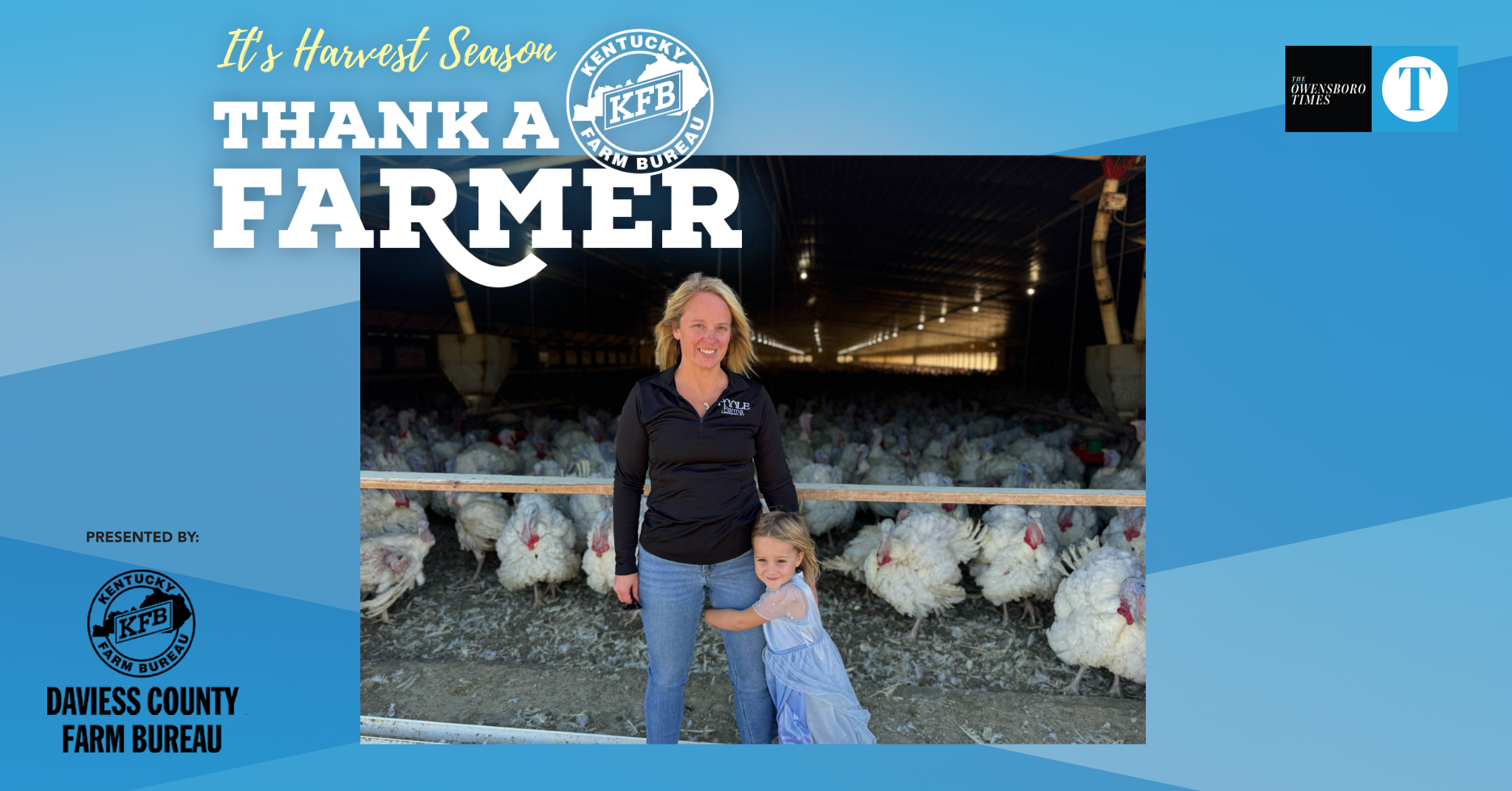
The Pooles operate six grow-out turkey barns, each designed to hold 9,400 birds. At full capacity, they manage roughly 54,000 tom turkeys at a time, cycling four flocks through the barns each year. The barns sit on their 640-acre homeplace that the couple reassembled from various family parcels, clearing timber to expand pasture and make the acreage more efficient.
“We’ve worked really hard to clear most of the timber off to make more pasture ground, to increase our herd size and be really efficient with the acres that we own,” Poole said.
Alongside the poultry, the Pooles run about 200 head of cattle, mostly mama cows with calves, and farm between 1,500 and 2,000 acres of corn and soybeans. Some acres are owned, and others are rented. Hay production supports the cattle.
The family shifted into turkeys after years of raising tobacco. Poole said Wes first connected with an Indiana-based integrator through Kentucky Farm Bureau’s Young Farmers program. Their birds are grown for Boar’s Head deli meat. Because they live on the east side of Daviess County near the new bridge, their flocks are serviced from a southern Indiana hub, even as a newer hub in McLean County serves many area growers.
“He kind of just tagged along and invited himself into this program,” Poole said. “Wes is very good at animal care, and it shows in his numbers and yields. They let him build three more barns after the first three.”
Poole estimates they built the barns in two phases, three around 2010 and three more a few years later.
Daily work inside the barns is steady and precise. The Pooles monitor ventilation, temperature, and other conditions with a computerized system that pings their phones. They make two full walkthroughs each day, a routine that adds up to several miles on foot while they check feed and water lines, remove mortality, and watch for any signs of stress or disease.
“The more you look at them, the better off you are,” Poole said. “They come to us at about two weeks old, about the size of a full-grown chicken, and we ship them at 45 to 50 pounds.”
When it is time to ship, the farm lights up. Poole said crews run roughly 30 semis a night for two nights to move birds from the six barns. Then comes a fast turnaround. Unlike many chicken operations, the Pooles clean out the barns after every flock. They wash the barns, put in new sawdust, and apply the cleaned-out litter to their crop ground, all within about a week, to support biosecurity and disease control.
Poole’s path to the farm blends education, industry experience, and a knack for hands-on work. She holds a degree in agricultural education from Western Kentucky University with a focus on ag mechanics, welding, and construction. Before coming home to the farm full-time in 2018 while pregnant with their third child, she spent a decade at Kentucky BioProcessing.
“I got into ag to follow Wes around and just fell in love with it,” she said. “I was on the welding team at Daviess County High School. The hands-on part kept me interested.”
She has also watched more women step into production roles.
“There used to be this idea of the ‘farmer’s wife’ just running parts,” she said. “Now you see women in tractors, combines, grain carts. I have friends where the wife runs the combine and the husband runs the grain truck. Everybody has their skill set.”
Poole said two women she knows in southern Indiana manage the turkey enterprise on their family farms as their sole responsibility.
Community ties are part of the Pooles’ operation. Jennifer serves on the Daviess County Extension District Board and the Conservation District Board, while Wes serves on the Farm Bureau board. Those networks, she said, help local agriculture pull together on efforts such as Ag in the Classroom, where farms and organizations across school systems collaborate.
“Farm Bureau is great at supporting other boards and providing speakers or training,” she said. “Cecil Farms, Reid’s Orchard, everybody comes together, even if you’re competitors.”
The past few years have tested grain producers with tougher markets, Poole said, even as cattle prices have remained strong. Diversification has helped Poole Farms ride out the swings.
“My advice would be for anybody to be as diversified as possible,” she said. “When you’re bringing people back on the farm and supporting more families, being diversified helps reduce the risk.”
Her work has drawn recognition. Poole was runner-up for Kentucky Farm Bureau’s 2025 Farm Woman of the Year and was also runner-up last year. She serves on the Kentucky Poultry Federation board and is helping launch Kentucky Teen Poultry, a new initiative to sponsor running events statewide promoting poultry, lean protein, and healthy lifestyles.
In her downtime, Poole runs. She plans to complete her first full marathon on Nov. 8 in Indianapolis.
“I’m proud to represent Daviess County,” she said. “We’ve built this farm piece by piece, and we’re grateful for the community that helps make it possible.”