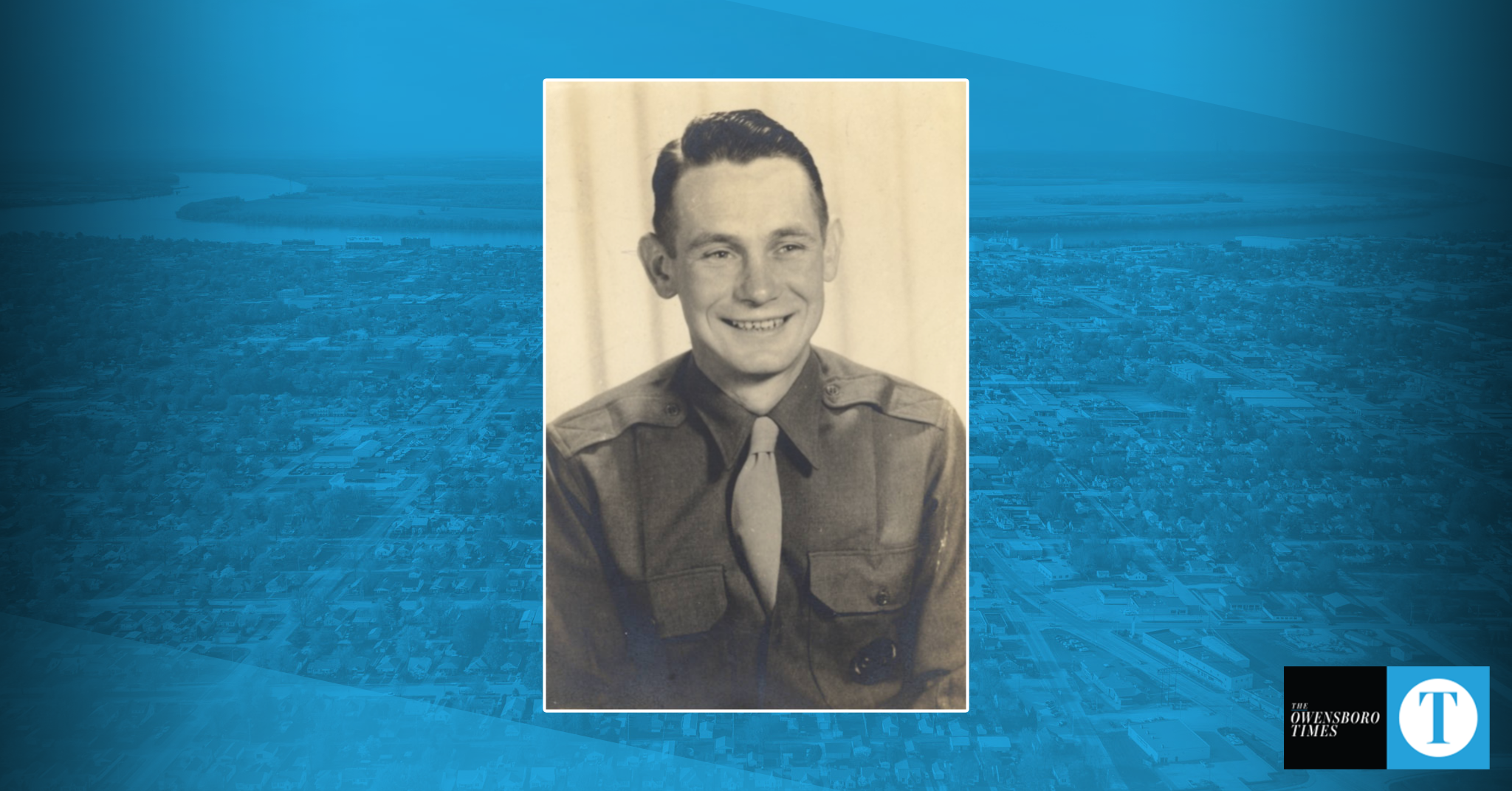
On June 6, 1944, First Lt. John Spalding of Owensboro led 32 men of the U.S. Army’s 1st Infantry Division onto Omaha Beach. They were among the first Americans to charge through the surf and up the cliffs of Normandy.
Spalding survived that morning of chaos and gunfire, earned the Distinguished Service Cross for valor, and later served in the Kentucky House of Representatives.
Fifteen years later, the decorated D-Day hero was found dead in his Owensboro home — shot as he slept, the victim of a tragedy that underscored the war’s toll long after the fighting ended.
Emily Bolin never met Lt. John Spalding, but after hours spent scanning his letters, photos, and war records in the Kentucky Room at the Daviess County Public Library, she speaks of him as if he were an old friend.
“I feel like I know this man personally, because I have done so much research on him and his family,” said Bolin, a library associate who works with genealogy and local history. “He died 66 years ago yesterday. But I feel like I know him very well.”
Spalding’s story is preserved today in archives from Ohio University to New Orleans, in a New York war chronicle, and in a collection of family letters now being digitized in Owensboro. Local resident Dave Roberts is leading a push to place a plaque in Spalding’s honor, saying the tribute would recognize not only a D-Day hero but all veterans who carry invisible scars home from war.
“This story needs to be memorialized,” Roberts said. “He was part of history on one of the biggest days of World War II, and people here had never heard about him.”
From ‘Sport Sparks’ to Fort Benning
According to Bolin and documents in the library’s digital archive, John M. Spalding was born in Evansville, Indiana, and moved to Owensboro as a toddler. His family made the city home, and Spalding came to love it. He attended St. Joseph Academy, then left school early in the 1930s to help support the family.
Bolin said Spalding worked for the local paper, writing a sports column called “Sport Sparks,” and held a part-time job at Interstate department store, selling clothing and housewares. Bolin said he was known as good with people even before the war.
Spalding enlisted in the Army in 1941. Archival records show he first served in Iceland, then was commissioned as a first lieutenant after training at Fort Benning, Georgia.
By late 1943, his unit — Company E, 16th Infantry Regiment, 1st Infantry Division — had moved to England, where they ran exhausting practice landings in preparation for an invasion they knew was coming, according to a wartime interview preserved in the Cornelius Ryan Collection of World War II Papers at Ohio University.
First day of combat: Omaha Beach
D-Day, June 6, 1944, was Spalding’s first day in combat.
Multiple accounts, including his own detailed statements to Army historians, an interview held in Herve, Belgium, in February 1945, and a questionnaire later sent to author Cornelius Ryan, describe how Spalding led the first section of Company E as part of the initial assault wave on Omaha Beach.
Bolin said he commanded 32 men that morning. They were told the Navy would put them ashore dry-shod under the cover of bombing from the air.
“They thought that they were going to be so well-protected from the sky,” she said. “Nothing went as planned.”
According to the Eisenhower Center transcript, Spalding’s men loaded into landing craft around 3 a.m. in rough seas. Many were seasick before they ever saw France. As the boats neared shore around 6:15 a.m., enemy artillery and machine-gun fire tore into the water. Spalding stepped off expecting shallow surf, then disappeared under the waves with 50-80 pounds of equipment on his back.
“I swallowed so d**n much salt water trying to get ashore,” he later told interviewers, recalling how some men drowned before reaching the sand.
His section lost weapons, mortars, and a flamethrower in the surf, but the men who kept their rifles were able to fire as soon as they hit the beach. Spalding wrote that their first casualty came at the water’s edge, then another BAR gunner was hit shortly after they reached cover.
The company faced mines, artillery, and interlocking machine-gun fire. In his account, Spalding described how he and his second-in-command, Staff Sgt. Philip Streczyk, a battle-hardened veteran of North Africa and Sicily, led the men off the exposed beach, through minefields, and up a narrow trail toward the German strongpoints overlooking the shore.
Bolin said that by circling behind those positions and taking them out, the small unit opened a path for more Allied troops to move inland.
“They kind of made a path going around,” she said. “By taking out that strong point, that allows more allies to come in.”
Military histories, including David Allender’s book “Until the Victory Is Won,” published by War Chronicle in New York, credit Spalding’s section with being among the first American soldiers to get behind German lines above Omaha Beach.
For his actions that day and in subsequent fighting, Spalding was awarded the Distinguished Service Cross for valor, according to Allender and a nomination form filed with the 16th Infantry Regiment Association.
Wounds seen and unseen
The combat did not end in Normandy. Bolin said Spalding later fought in Belgium and was wounded by shrapnel in the thigh during the Battle of Aachen, earning a Purple Heart and spending about three months recovering. He returned to the front and served through the Battle of the Bulge.
By early 1945, Army Retirement Board records show, Spalding was evacuated to the United States with a severe respiratory illness and what was then called “combat fatigue.” He reported nightmares, combat dreams, depression, and a loss of confidence in his ability to lead men in battle.
Allender wrote that by the winter of 1944-45, Spalding was so exhausted that he could not go on; the strain of command during the Bulge had grown “worse and worse” until he stopped sleeping altogether. The Army wanted him to train troops stateside, but he refused after developing an intense hatred of guns.
“He came home a different man,” Bolin said. “Even though he came home from the war, he still gave all. No, he didn’t physically die at Normandy, but a part of him did.”
She said family members told her he became a functional alcoholic, self-medicating during an era when there was little formal help for post-traumatic stress.
“There just wasn’t any help,” Bolin said. “You were kind of expected to come home and assimilate into civilian life and just kind of get over what you saw.”
Lawmaker and community leader
Spalding returned to Owensboro in 1945. He went back to work at Interstate department store, eventually managing the men’s department, according to Bolin and city directories.
At the same time, he entered politics. Bolin said records show he served two consecutive terms as a Democrat in the Kentucky House of Representatives in the late 1940s and early 1950s. He championed issues such as reforestation of strip-mined land and improved dental care for children, positions that were considered forward-looking for the era.
Roberts said he also found references to Spalding serving on the board of a home for children who had lost parents during wartime.
“He felt more in tune with that than anything,” Roberts said of Spalding’s own description of the role.
A family burdened by war
Spalding’s personal life was complicated. According to Bolin and court records she has reviewed, he married his first wife, Perdetta, before the war, and they had a son, Ronnie. Their marriage was strained by his long absences, Bolin said. The couple separated in June 1946, and Spalding married Mary Christine Love in October that same year.
He and Mary Christine had three more children together. Bolin said divorce and remarriage in such quick succession were unusual in Owensboro at the time, another sign of a family under stress.
Bolin noted that all four Spalding brothers served in World War II — two in the Army and two in the Navy — and all four returned home. One brother, Joe, was present at Pearl Harbor during the Japanese attack.
“Their poor mother, you know, sending four boys off to war,” Bolin said. “Two of them lived through two of the most major events in World War II.”
A tragic end at home
The most painful part of Spalding’s story came 15 years after he survived Omaha Beach and the Bulge.
On Nov. 6, 1959, he was shot and killed while asleep at home in Owensboro. Bolin said court and hospital records show his wife, Mary Christine, had secretly purchased a .22-caliber rifle and later shot him, striking an artery. Authorities were not notified for several hours.
Bolin emphasized that both spouses were struggling with mental illness and alcoholism.
“I usually just kind of describe it to people as it being like a perfect storm,” she said. “They both needed help, and there wasn’t any help.”
Court records show Mary Christine Spalding was later found mentally incompetent to stand trial and was committed to Western State Hospital in Hopkinsville. She spent the rest of her life in and out of psychiatric facilities and died in 1991, according to Bolin’s research.
Their children, suddenly without either parent, spent part of their childhoods in an orphanage, Roberts said.
“It was really a pretty dysfunctional type setting for those kids,” Roberts said.
Remembering a forgotten hero
Roberts said he first learned about Spalding when someone sent him a four-minute video segment from the 80th anniversary of the Normandy landings that mentioned the Owensboro sportswriter who led one of the first groups behind German lines.
“I thought, ‘How come I’ve never heard about this guy before?’” Roberts said. “I started doing some research, and almost every book that you pick up that shares the story of Omaha Beach talks about John Spalding.”
Those sources include Allender’s “Until the Victory Is Won,” various D-Day histories, the Cornelius Ryan papers, and the Eisenhower Center interview housed in New Orleans.
Roberts contacted Spalding’s granddaughter, Tina Gerteisen. She had kept many of Spalding’s letters home to his mother, along with medals and photographs, but worried no one in the next generation was interested.
At Roberts’ urging, Gerteisen donated the materials to the Kentucky Room so they could be preserved and shared with the public. Bolin has scanned and transcribed the letters as part of the library’s digital archive.
“I’m hoping that those who hear his story will kind of feel a connection and a kinship to him,” Bolin said. “Especially those who have been in the armed forces and have come home and felt like a different person.”
Roberts has since spoken to civic and church groups, written the script for Spalding’s portrayal in the Voices of Elmwood cemetery tour, and is working with city officials on a modest memorial.
Roberts believes Spalding’s story, and the Distinguished Service Cross pinned on him by Gen. Dwight D. Eisenhower, set him apart.
“We have all these memorials for soldiers who died and never came home,” Roberts said. “What we don’t have is something that says these veterans came back with physical and mental scars. John didn’t come back the same man that left Owensboro.”
For Bolin, the hope is that Spalding’s story will resonate far beyond one local hero.
“For those who have had PTSD, to know that they’re not alone,” she said. “Now we have more resources than ever, but it’s still difficult to treat. Maybe when people hear his story, they’ll see themselves in him.”