Long before runners line up on Veterans Boulevard, the work of putting on the Wendell Foster Half Marathon and 5K gets well underway.
For Kara Howard and her team at Wendell Foster, the race is not a one-day event but a year-round effort involving staff, volunteers, and multiple city departments.
“We plan all year,” Howard said. “We’ll finish the one this year on March 28, and we’ll immediately start planning for the next one. I mean, we’re already planning for the next one.”
Howard said the internal race team includes five primary roles, along with a larger committee.
“I have a team of five people, including myself — a race director, an assistant race director, a Steps Division coordinator, an expo coordinator, and a volunteer coordinator — plus we have a committee of about 12 more people,” she said.
That committee is made up mostly of Wendell Foster staff, but also includes community members and experienced runners who want to see the race continue to grow.
“They love this race and want to make sure it continues and is successful,” Howard said. “It’s not only a great thing for Wendell Foster, but it’s a great thing for the Owensboro community.”
The race began in 2019 and was intentionally scheduled in March, which Howard said aligns with the organization’s mission.
“Our inaugural race was in 2019,” she said. “We held it in March because March is really important to us as an organization. We empower people with disabilities, and March is Disability Awareness Month.”
Like many events, the race was disrupted by the pandemic. It was canceled in March 2020 and later moved to November in 2021 and 2022 before returning to its original month.
“We took a big risk whenever we decided to shift it back to March,” Howard said. “To do that, we had to skip a year in 2023, and we were back in action in March of 2024. We were nervous about what that would do for participation, but the community really showed up.”
Howard credited John Gleason with building the race from the ground up.
“John Gleason is the brains behind all this,” she said. “He got it going, and that’s the hardest part. He built something that we were able to carry forward and really grow from there.”
Growth has come not just in numbers, but in opportunity. The race began as a half-marathon only. Organizers later added a 5K and additional divisions to make it more inclusive.
“Not everybody wants to do a half-marathon,” Howard said. “It’s a lot of miles. We wanted to offer something where more people could participate.”
One of the most mission-driven additions is the Steps Division, designed specifically for people with disabilities.
“It’s a division of the race where people with disabilities can sign up, and they can take steps across whatever time span works well for them,” Howard said. “At the end of that, they track their steps and can achieve their goal of reaching a half-marathon or a 5K. They cross the finish line with us on race day, just like all of our other athletes.”
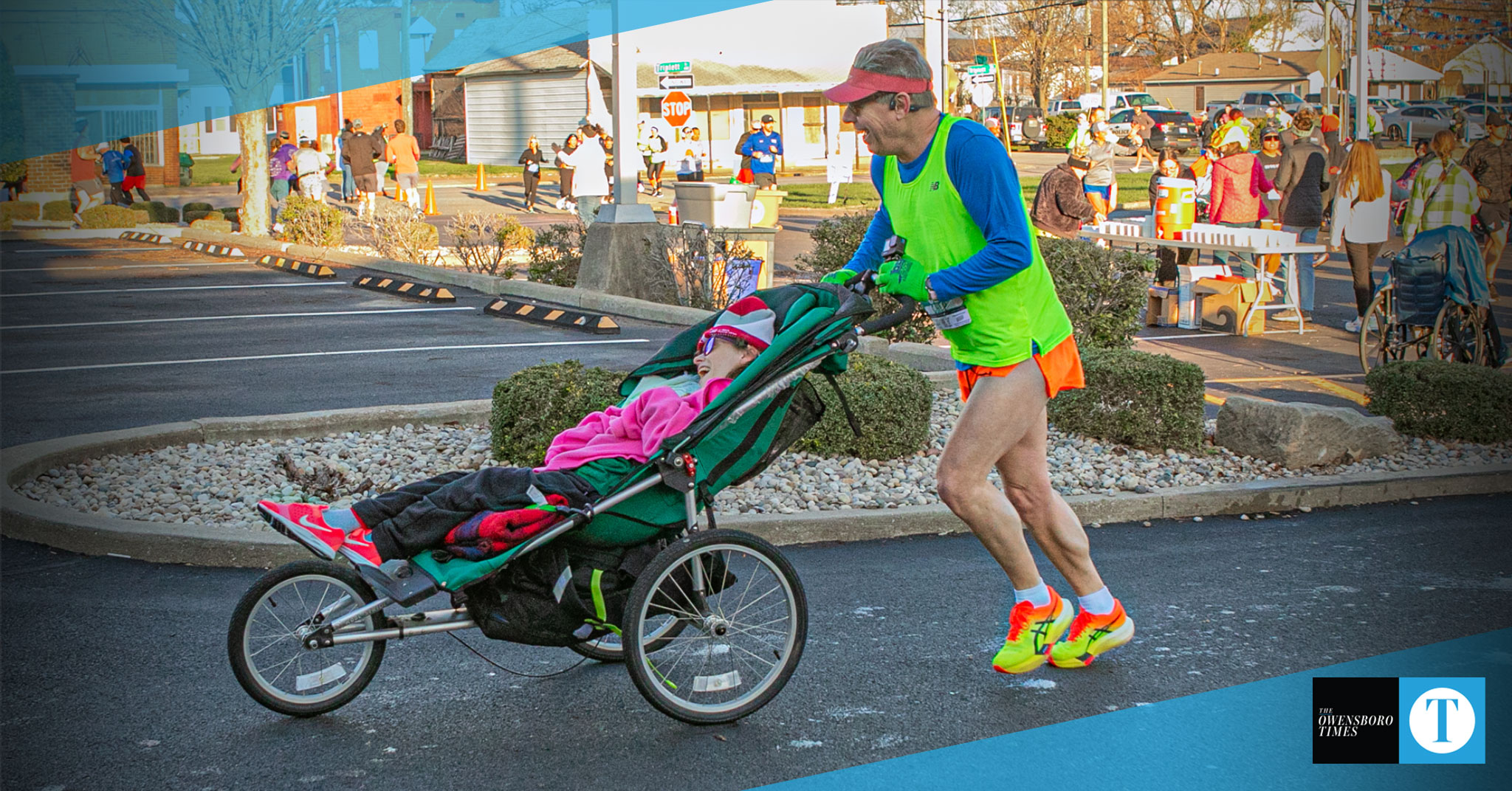
The event also includes a duo team division, where an athlete pushes a person with a disability in a stroller.
“We like to call it a race for everyone,” Howard said. “You can run it, you can walk it, you can step it, you can ride it. We’ve tried to come up with ways so that everyone has an opportunity to participate and get that feeling of crossing the finish line.”
Participation has steadily increased. Howard said the inaugural race drew around 800 runners, while last year’s event topped 1,100 participants.
“This year, we’re hopeful to reach our goal of 1,200,” she said.
Runners now come from well beyond Kentucky and Indiana.
“We’re bringing in people from all over the country,” Howard said. “Right now, we’re sitting at about 15 states.”
Howard said the goal is to provide a big-race experience in a mid-sized city. That includes a race expo at the Owensboro Convention Center the day before the event, along with pre- and post-race gatherings designed to highlight local businesses.
“Our goal is really to give people that big city, big race feel and experience right here in Owensboro,” she said. “We’re passionate about the city that we live in, and if we can give people a great experience and show them what Owensboro has to offer, we absolutely will do that.”
While Wendell Foster handles race operations, the City of Owensboro plays a major behind-the-scenes role in making the event possible.
Tim Ross, the City of Owensboro’s director of public events, said coordination begins months in advance.
“My office works with Kara and her team really throughout the year,” Ross said. “We meet three or four times a year in planning and looking at routes, times, and all kinds of logistics pieces to it, to make sure it’s going to work for them and to minimize the impact around the community and ensure the safety of the runners.”
Ross said race day requires significant manpower from several departments.
“We’ve got more than 50 staff that are working between PD, fire, and public works,” he said. “There’s probably upwards of 50 to 60 between those three departments that are out there that day to support the race course and the event.”
Public Works crews handle road closures and traffic control.
“Public Works has probably 15-plus folks out there to set up those closures and take them back down again as the runners finish different sections,” Ross said.
Fire personnel are positioned along the course to respond quickly to any medical issues.
“They’re out a little bit closer to all the action rather than being back at the station that morning,” Ross said.
Howard said that to participants and spectators, race day can look seamless. But she emphasized that it only appears that way because of the preparation behind it.
“It looks like it just happens,” she said. “But it doesn’t just happen. It takes so much leadership, coordination, and direction.”
Volunteer support is another critical piece. Howard said last year’s race relied on more than 400 volunteers, accounting for roughly 1,200 hours of service.
“Volunteers are really the foundation of an event like this,” she said.
After months of meetings, emails, route adjustments, and staffing plans, Howard said the payoff comes when runners gather at the starting line.
“Through all the hard work and the late nights and the early mornings and all the man-hours, it all leads to the magic of race day,” she said. “There really is nothing better than seeing those 900 to 1,000 people lining up on Veterans Boulevard, no matter the weather.”