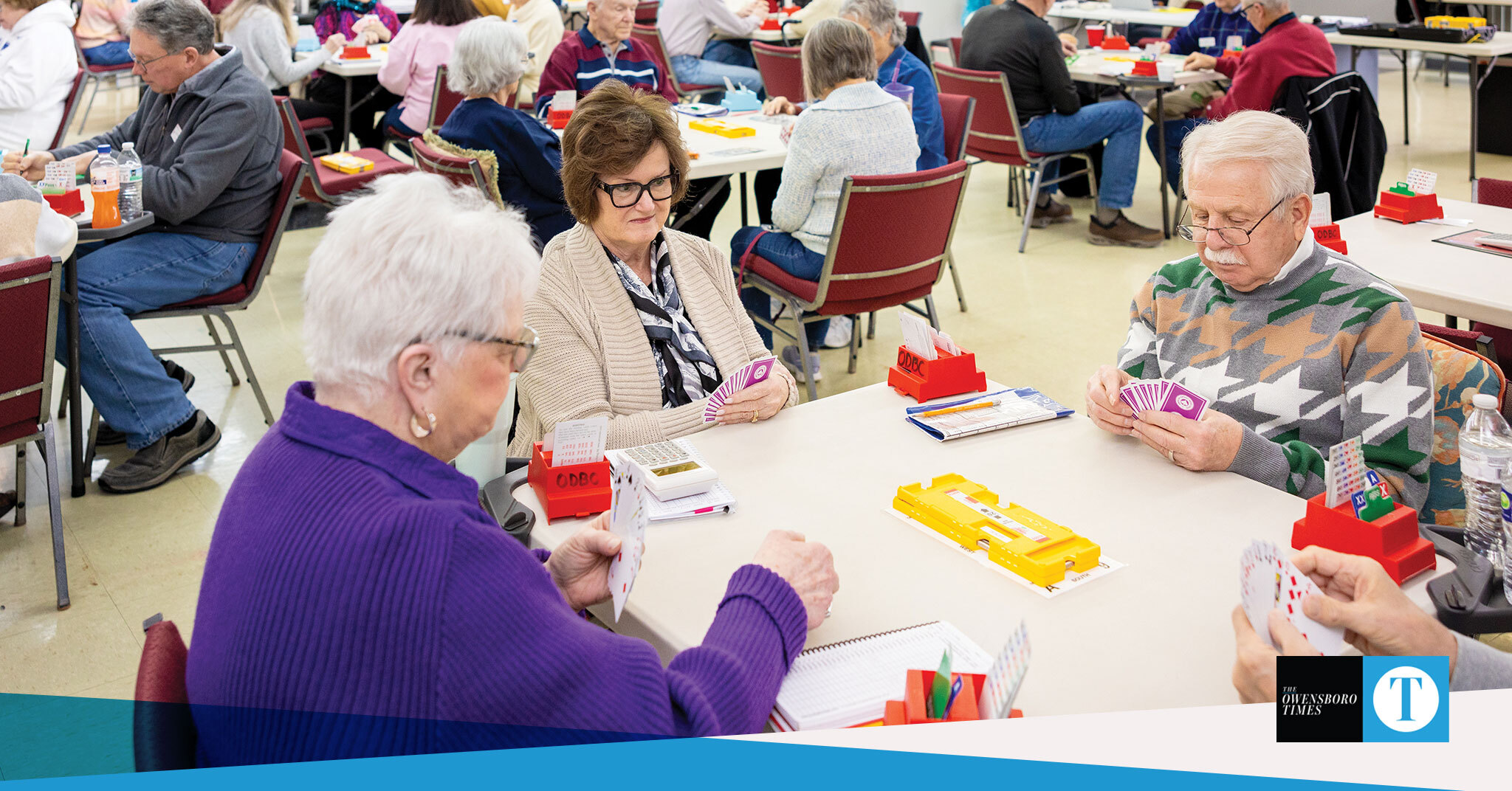
On most Monday nights in Owensboro, a room full of people gathers around card tables in near silence. Not out of boredom, but concentration. No music plays. No one scrolls a phone. Eyes stay fixed on 13 cards and the four that hit the table each trick. Then, as soon as a round ends, the quiet breaks into laughter, chatter, and good-natured debate before the next set of opponents sits down.
It looks simple from the outside: just a card game. But inside the Owensboro Duplicate Bridge Club, every decision is measured, every bid carries meaning, and every play is tracked, remembered, and compared. Players aren’t just trying to beat the pair across from them. They’re competing against everyone else in the room who will play the exact same hand later that night.
That structure is what makes duplicate bridge different, and what has kept the local club active for more than 60 years.
The club was incorporated in 1962, though organized bridge play in Owensboro began even earlier. Today, the group has just over 100 active members and hosts three games each week at the Odd Fellows Lodge on Breckenridge Street. Sessions run Monday evenings from about 6-9:30 p.m. and Wednesday and Friday afternoons from 1-4:30 p.m., with players arriving early to visit before cards are in play.
Club President Jeff Ebelhar said many people are familiar with social or “rubber” bridge, where each deal is unique and luck of the cards can heavily influence results. Duplicate bridge removes much of that randomness. Hands are pre-dealt and placed into boards, then passed from table to table so multiple partnerships play the identical cards. Scores are later compared using a matchpoint system based on relative performance.
“In duplicate bridge, you’re not just playing the two people at your table,” Ebelhar said. “You’re competing against every other pair that played that same deal to see who got the best outcome from those cards.”
A typical session includes between 22 and 27 boards. Partnerships stay together throughout the game while opponents rotate. Players may sit North-South or East-West and move accordingly after each round. The goal is consistency: bidding accurately, counting cards, managing risk, and squeezing out extra tricks whenever possible.
“It’s a room full of card counters,” Ebelhar said. “If you’re going to be any good at it, you have to keep track of what’s been played — how many hearts are gone, whether a high card is still out, things like that. It really exercises your brain.”
Attendance varies by day, but Monday night is typically the largest session, often drawing 60 or more players and filling 15 or more tables. Recent peak nights have approached 70 players. Wednesday and Friday afternoon games are smaller but steady, commonly drawing 40-50 participants. Because many members are retired, daytime games remain popular, while Monday nights attract those who still work during the day.
The age range stretches wider than many might expect. The youngest regular player is a college student from the University of Evansville. The oldest active member is in her 90s and has belonged to the club for roughly six decades.
“She’s one of the best players we have,” Ebelhar said. “I joke that I hate sitting down at a table against her because she beats me every time.”
Skill levels vary widely, and the club is structured to keep newer players engaged. Those with fewer than 100 masterpoints — the rating currency of competitive bridge — can play in a novice section, where they compete only against similarly ranked players. Once they cross that threshold, they move into the open division alongside more experienced competitors.
That progression helps prevent beginners from being overwhelmed and gives them time to build confidence.
“We want people to enjoy it and stick with it,” Ebelhar said. “If you throw someone brand new against a Life Master who’s been playing for decades, that’s discouraging. The novice side gives them a place to learn and compete at the same time.”
The club is affiliated with the American Contract Bridge League, the national governing body for duplicate bridge in the United States. Players earn masterpoints based on performance, with larger events awarding more points. Achieving Life Master status requires at least 500 points across different event categories, including higher-value tournament finishes.
Approximately 25 Owensboro members have reached Life Master rank. Earning that level typically takes years of steady play and frequent tournament participation.
At the rate many club games award points — often just one or two per strong finish — progress can be slow but steady. Tournament success can accelerate that pace, but it requires travel and tougher competition. The Owensboro club belongs to a regional unit that includes Evansville, Vincennes, and Jasper, Indiana, along with Madisonville, Hopkinsville, and Clarksville, Tennessee. Players from those cities often travel to Owensboro to compete, and local members attend regional events.
A regional tournament known as the Sweetheart Swiss is scheduled to be held in Owensboro in February, drawing competitive players from across the unit.
Despite the competitive framework, members describe the culture as welcoming and social. Between rounds, the room fills with conversation. Partnerships discuss hands, compare choices, and occasionally replay pivotal moments. Many players schedule regular partnerships and build long-term playing relationships, including married couples who team up at the table.
Ebelhar said duplicate bridge demands more frequent play than many expect.
“I played social bridge for years, maybe 10 times a year,” he said. “But duplicate is different. If you want to improve, you really need to play multiple times a week. It’s like golf, where the people who are good at it play often.”
The club’s membership dipped during the COVID-19 pandemic, when in-person gatherings paused and some players were hesitant to return immediately. Since then, participation has steadily rebounded, with table counts growing and lesson programs restarting.
Beginning bridge lessons are scheduled to launch in March, open to anyone interested in learning the game. Organizers say no prior duplicate experience is required, though comfort with card games helps. Historically, about half of those who start lessons continue into regular play after experiencing the competitive format, Ebelhar said.
While strategy and scoring drive the game, members say community is what sustains the club. One example is the group’s annual Christmas fundraiser, which supports St. Benedict’s Homeless Shelter. What began about a decade ago as a small holiday effort has grown significantly, with recent events raising thousands of dollars. This past year’s fundraiser collected roughly $8,000 for the shelter.
“It’s a generous group,” Ebelhar said. “People care about each other and about the community.”
For newcomers walking in for the first time, the scene can feel intense: rows of tables, score slips, bidding boxes, and unfamiliar terminology. But regulars say the structure quickly becomes familiar, and the challenge is part of the appeal.
“It’s not just playing cards,” Ebelhar said. “It’s thinking, planning, remembering, adjusting. You’re working with a partner, and you’re always trying to do a little better than the last hand. That’s what keeps people coming back.”