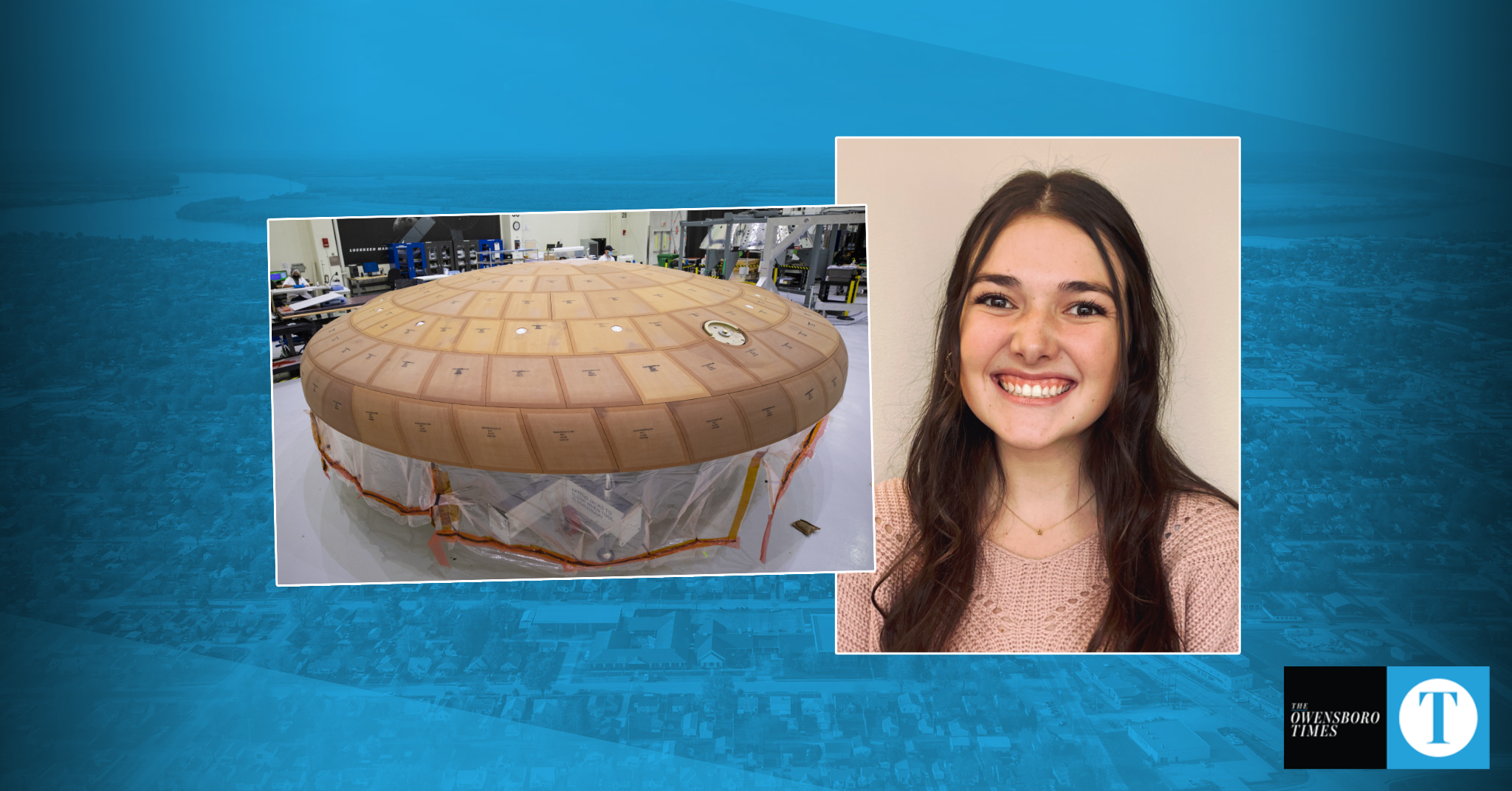
Owensboro native Kate Rhoads is playing a role in one of NASA’s most high-profile missions — Artemis II, the first crewed mission to travel around the moon in more than 50 years — contributing research that helped inform improvements to the spacecraft’s heat shield.
Rhoads, a 2019 graduate of Daviess County High School, is currently pursuing her Ph.D. in aerospace engineering at the University of Kentucky and working as a NASA fellow. Her research focuses on thermal protection systems — specifically how heat shield materials behave under extreme conditions.
Rhoads said she didn’t initially plan to pursue engineering.
“I didn’t really know that engineering was a possible career choice until junior year of high school,” she said, crediting a teacher who encouraged her to explore the field.
That interest led her to study mechanical engineering as an undergraduate at UK before transitioning into aerospace engineering for her doctoral work. Along the way, she became involved in research and eventually earned a NASA fellowship after proposing a theory related to issues seen during the Artemis I mission.
Following Artemis I, engineers identified unexpected damage to the spacecraft’s heat shield, including chunks of material breaking off during reentry.
“There were large bursts of particles breaking off of the material that they didn’t expect to happen,” Rhoads said. “It wasn’t a failure because they were able to recover the capsule, but there were large amounts of heat shield pieces that were unaccounted for.”
Rhoads’ research focused on understanding why that occurred. She said the issue stemmed from internal pressure building up within the material, causing sections to crack and break away before they could properly dissipate heat.
“That is what ended up happening,” she said. “There ended up being a buildup of internal pressure, which caused that cracking and bursting.”
Rather than redesigning the material entirely for Artemis II, engineers adjusted how the spacecraft reenters Earth’s atmosphere.
“They needed to be able to reduce the amount of pressure that would build up behind the material,” Rhoads said. “So they changed the angle of the vehicle so there wouldn’t be as much mechanical stress.”
Rhoads works as part of a broader research effort at UK, which has a strong thermal protection systems program that collaborates with NASA. While multiple universities studied the Artemis heat shield issue, Rhoads said UK’s expertise helped position it as a key contributor.
Personally, Rhoad’s work centers on testing and modeling how materials respond to extreme heat. She said heat shields used on missions like Artemis II are designed to be “ablative,” meaning they intentionally burn away to carry heat away from the spacecraft.
“They get rid of thermal energy through mass loss,” Rhoads said. “They’re designed to burn up and carry heat away from the material itself.”
According to NASA, the spacecraft travels about 25,000 mph during reentry, with outside temperatures reaching nearly 5,000 degrees Fahrenheit. The heat protection system, however, keeps the cabin temperature in the mid-70s.
Rhoads said being part of the research tied to Artemis II has been both exciting and surreal. She watched the mission’s reentry during a university-hosted watch party, describing the tense moments during the communications blackout as “nerve-wracking.”
“When it came back, it was definitely a relief,” she said.
She will continue working on the program this summer, traveling to Houston for a 10-week rotation where she’ll help analyze post-flight data from Artemis II — research that could inform future missions.
Rhoads also pointed to future exploration efforts, including missions to Mars and beyond, saying “There are a lot of really cool missions that require these heat shield materials.”
With about a year left in her Ph.D. program, Rhoads expects to transition into a full-time role with NASA, though she’s still determining where she’ll be based.
Looking back, she said one of the biggest lessons is that opportunities in aerospace research aren’t limited to major cities.
“I wish that I had known before going to college how much opportunity there was in aerospace in Kentucky. You don’t think about the opportunity to do intense research for places like NASA in your home state,” she said. “If you work really hard, you can create the opportunity yourself. Don’t sell yourself short not knowing what you can accomplish.”