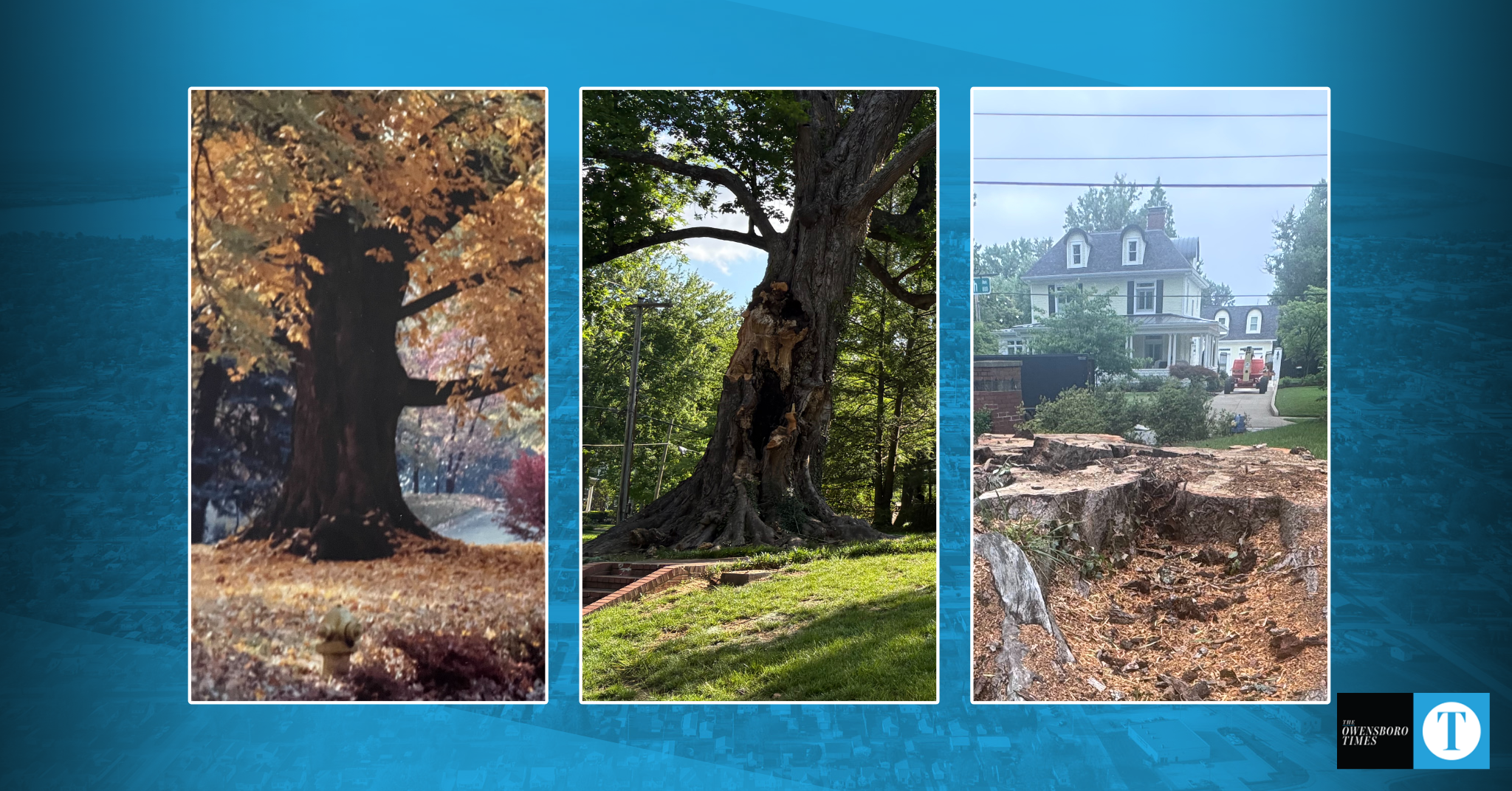
A towering sugar maple believed to have stood for nearly 300 years — and officially recognized as Kentucky’s champion sugar maple — has been removed from Owensboro’s Littlewood neighborhood, marking the end of one of the city’s most recognizable natural landmarks.
Phil and Nancy Malone, who have lived at the home since 1980, said the massive tree had become a beloved fixture for generations of neighbors, photographers, children, and passersby.
“It was a friend to everybody,” Nancy said. “People would come by and just sit and look at the tree. Our children and grandchildren climbed that tree. We shared it with everybody.”
The tree stood at the entrance of Littlewood and was officially named Kentucky’s champion sugar maple in 2011 through the Kentucky Division of Forestry’s Champion Tree Program.
A Sept. 1, 2011, letter from the Division of Forestry informed the Malones that their nomination had been successful and that the sugar maple was “indeed the largest of its species and is now the current champion.”
The Malones said the tree likely predated both the development of Littlewood and the founding of Owensboro itself.
“This house was built in 1937, and we’ve heard for years that the street was developed around that tree,” Phil said. “They say Mr. Freeman Little altered the position of the street coming in because of the size of the tree.”
Littlewood was developed in the mid-1930s by Freeman Little, whose name remains attached to both the neighborhood and nearby Freeman Avenue.
The tree’s massive size and prominence made it a defining feature of the property and neighborhood.
“We measured the trunk at around six feet in diameter,” Phil said. “The foresters factored in the height, the circumference, and the spread of the crown and determined it was the largest sugar maple tree in Kentucky.”
The tree reportedly stood between 80 and 90 feet tall.
“Steve Harmon Tree Service estimated it was around 80 to 90 feet because that’s as high as their bucket would go,” he said.
Nancy said arborists had monitored and cared for the tree for years.
“We’ve nursed this tree for years,” she said. “We’ve had arborists here to make sure it wasn’t diseased, and we had it trimmed regularly.”
Despite those efforts, the couple said storm damage and internal decay eventually made removal unavoidable.
A large limb fell during a storm in April, exposing deterioration inside the tree.
“When that limb broke off, it opened up the inside, and we could tell it was diseased,” Phil said. “We felt like it had become potentially dangerous for people walking up and down the street. It was not an easy decision.”
Nancy said another large limb had fallen several years earlier while the couple was out of town.
“With time, and the wind, and everything else, it just weakened,” she said.
Removing the tree became a major undertaking. The process lasted several days and required cranes capable of lowering the massive limbs and trunk sections safely to the ground.
“At first they removed what they could reach with a bucket and lowered sections down by rope,” Phil said. “Then they had to bring in a larger crane that could handle the weight of the bigger limbs and pieces of the trunk.”
The Malones said the tree played a central role in neighborhood life for decades. Children once gathered beneath it while waiting for the school bus, and countless prom, graduation, and wedding photos were taken in its shade.
“A professional photographer who lived nearby loved using the tree because of the shade and the character of the trunk,” Phil said. “A lot of people had pictures made there.”
The tree also became part of neighborhood lore.
“One of the pranks years ago was for boys to come by and roll the tree with toilet paper,” Phil said. “Sometimes we’d wake up and it looked like snow.”
Nancy recalled now local funeral director Glenn Payton Taylor, Jr. once asking permission to collect leaves from the tree for a scrapbook project.
“He knocked on the door and said, ‘Miss Malone, do you mind if I borrow two of your leaves?’” she said.
The loss of the tree is expected to dramatically change the appearance of the property and surrounding streetscape.
“It was like a big umbrella shielding the house from the western sun,” Phil said.
The couple said they plan to eventually plant something else on the property, though not directly atop the original root system.
“We’ll plant something around there,” Nancy said. “But probably not exactly where it was because all those roots are still there.”
Though saddened by the loss, the Malones said they are grateful so many people were able to enjoy the tree through the years.
“It’s emotional, but it had to be done,” she said. “Everybody has enjoyed it, and that’s what makes me happy.”