As the United States approaches its 250th anniversary, four men buried in and around Owensboro offer a direct link to the nation’s founding and to the earliest days of this community.
George Calhoon, William Smeathers, Benjamin Field, and Thomas Moseley all served during the Revolutionary War, according to pension records, local histories, and family research. Long before Owensboro became a city, all four men helped shape life on the Kentucky frontier.
Their graves remain in local soil. Their names still surface in pension files, old newspapers, county histories, and family records. And as the nation prepares to mark 250 years since the Declaration of Independence in 2026, their lives raise a timely question: Who among their descendants may still be here, carrying pieces of those stories forward?
For Jean Owen, that connection is personal.
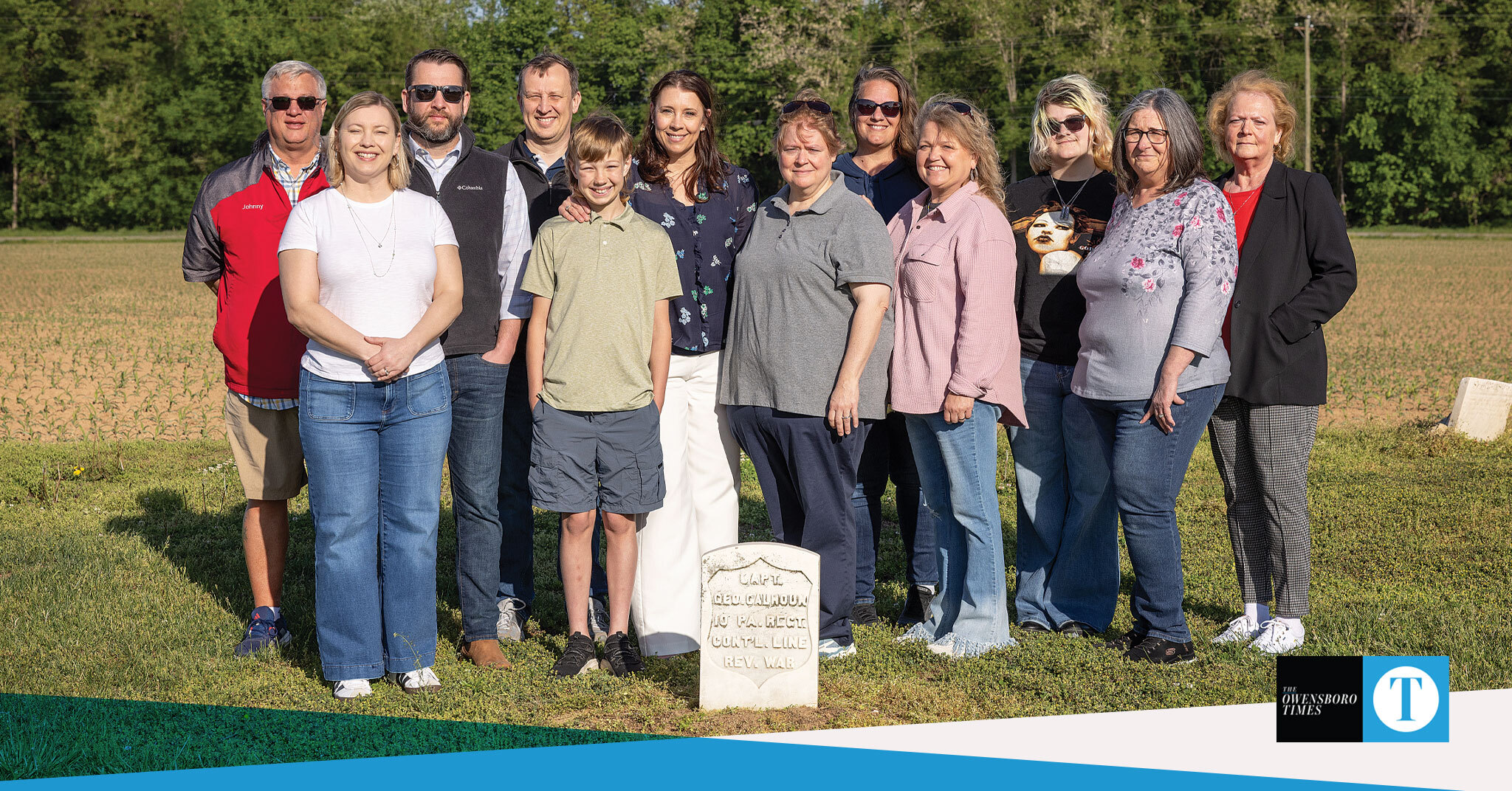
“He’s my fifth great-grandfather,” Owen said of George Calhoon.
According to his pension application filed in Daviess County in 1832, Calhoon was born Feb. 1, 1754, in Lancaster County, Pennsylvania, and entered service in 1776 as a third lieutenant in the Pennsylvania militia. He said he joined what was known as the “flying camp,” a mobile defensive force, serving under Capt. John McHatton.
In his sworn statement, Calhoon described marching to Fort Lee in New Jersey and Fort Washington in New York during the early stages of the war. He told the court he witnessed the fall of Fort Washington from across the river after being sent away on assignment shortly before the fort was overtaken.
He later served as a quartermaster and then as a lieutenant in a ranger company, spending much of his time guarding the Pennsylvania frontier — a role that often meant daily skirmishes and constant movement through unsettled territory.
Calhoon also stated in a later filing that he participated in frontier expeditions in Kentucky under George Rogers Clark in 1782, including campaigns along the Miami and Wabash rivers.
Witnesses in Daviess County, including fellow veteran Anthony Thompson, supported his claims, and the court ultimately affirmed his service. He was granted a pension of $246.66 per year beginning in 1831.
Owen said her family’s understanding of Calhoon adds a deeply personal layer to that documented record.
“I have a letter that his great-grandson … wrote that George Calhoon never knew his parents,” she said. “They were murdered in a Native American attack, and he was taken in by the Native American tribe until he was rescued by a group of white settlers when he was a young boy.”
That account echoes narratives found in later regional histories, including the Biographical Cyclopedia of the Commonwealth of Kentucky, though historians acknowledge that frontier-era stories often blend fact and family tradition.
Owen said her family has spent years working to sort through those layers, particularly correcting confusion between Calhoon and another Revolutionary War officer with a similar name.
“They were confusing Lieutenant George with a Captain George,” she said. “We’re trying to correct the misinformation.”
According to Kentucky Family Records and other local sources, Calhoon moved to Kentucky after the war, living first in Nelson and Henry counties before settling in what is now Daviess County around 1811. He purchased land southwest of Yellow Banks and lived there until his death on Oct. 20, 1835.
He is buried on what is now the Bittel farm off KY 56, though Owen said even the historical marker there contains inaccuracies.
“It has him listed as a captain,” she said. “But he was a lieutenant.”
Despite those discrepancies, Owen said the connection remains meaningful.
“It makes me proud,” she said.
If Calhoon’s story reflects both documentation and rediscovery, the legacy of Benjamin Field stands out for the depth of its surviving records — and the dedication of descendants who continue to preserve it.
Born Nov. 14, 1755, in Culpeper County, Virginia, Field served in multiple roles during the Revolutionary War, including private, ensign, and captain, according to his pension file.
In a declaration filed in Daviess County in 1833, Field said he first volunteered under George Rogers Clark in 1780 and later received a captain’s commission in Virginia’s state line. He described traveling by river and overland routes to join military forces in the western theater of the war, including operations near the Falls of the Ohio.
Field also recounted losing nearly his entire troop in an engagement with Native forces near what was known as Floyd’s Defeat, a reminder of the dangers faced by soldiers on the western frontier.
The War Department later certified his service, awarding him an annual pension of $289.32 beginning in 1831. Additional historical accounts, including an 1842 notice in The Commonwealth of Frankfort, state that his commission was issued by then-Gov. Thomas Jefferson.
For Charlie Evans, a direct descendant, that history has been part of his life for decades.
“My mother was in the DAR, and I was a 7th-grader,” Evans said. “Our English teacher wanted us to write a paper on Kentucky pioneers, and my mother said, ‘You write about your great-great-great-grandfather.’”
Evans said that assignment marked the beginning of a lifelong connection to Field’s story — one that required persistence long before online genealogy tools existed.
“In 1957, my mother wrote the National Archives in Washington and asked for his military records,” he said. “They mailed back a copy of his commission.”
That document, Evans said, remains a prized family artifact.
“It’s to Captain Benjamin Thomas Field,” he said. “Signed by Thomas Jefferson.”
According to Kentucky Family Records, Field came to Kentucky in December 1795, when the region was still part of a rapidly expanding frontier.
Evans said the family’s oral history paints a vivid picture of that arrival.
“He landed where the VFW is today,” Evans said. “He left his wife and child on the flatboat, walked about 12 miles south toward Utica, started building a cabin, then came back, tore up the flatboat, and used the lumber to finish the house.”
Field’s postwar life centered on land, law, and leadership. Historical records show he worked as a surveyor, served as an assistant judge in Ohio County, and represented the county in the Kentucky Legislature in 1808.
Evans said Field also spent years surveying land tied to his extended family’s holdings.
“For 11 years after the Revolutionary War, he was surveying land in Kentucky,” Evans said. “Basically figuring out what his grandfather owned.”
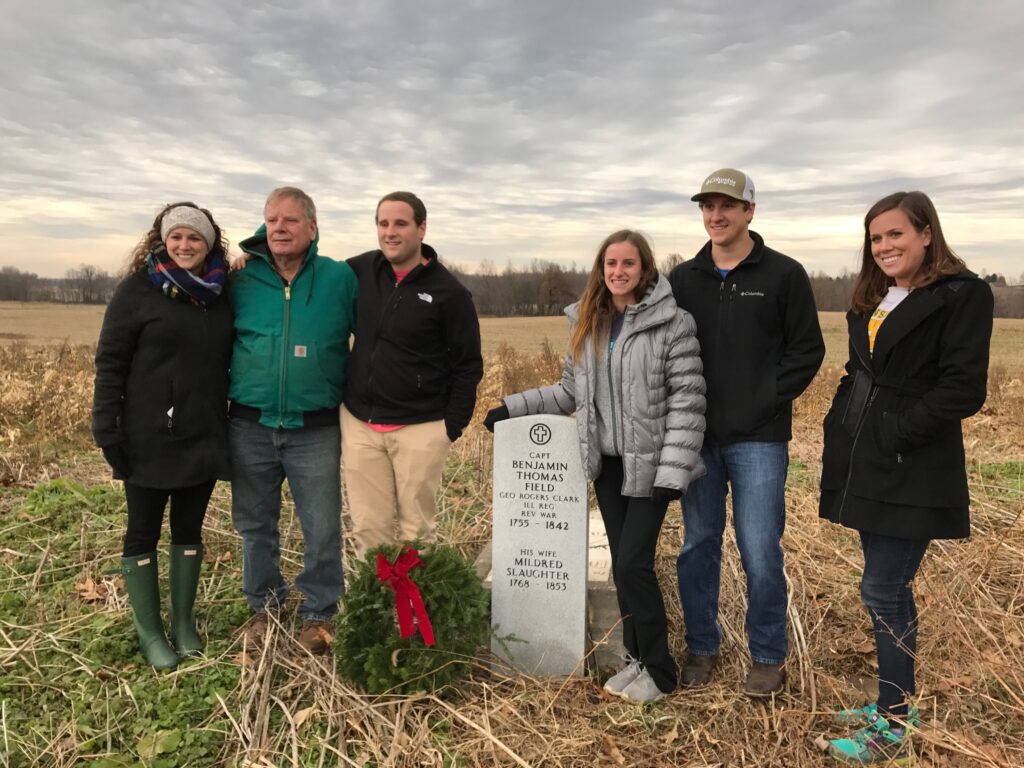
Field died Jan. 2, 1842, and was buried near present-day U.S. 431 north of Utica. His widow, Mildred, later filed for pension benefits, attesting to his service and their marriage dating back to 1790.
Evans said the cemetery where Field is buried remains intact but requires ongoing care.
“That little cemetery gets lost about every 25 years,” he said. “And then somebody finds it again.”
Evans himself rediscovered the site in 2014 after it had become overgrown and difficult to locate.
“I go out there once in a while and try to clean it up,” he said.
While Field’s legacy remains preserved through documentation and descendants, the life of William Smeathers — often called Bill Smothers — survives through a blend of record and folklore.
According to Kentucky Family Records and serialized accounts published in the Owensboro Monitor in 1866, Smeathers was born in Virginia in the mid-1750s and served during the Revolutionary War, including participation in the Battle of King’s Mountain under Col. Isaac Shelby.
Those accounts describe him as a frontier orphan whose father was killed by Native Americans, a man who grew up hardened by loss and wilderness life before eventually heading west in search of opportunity — and conflict.
After the war, Smeathers came to Kentucky, first helping establish frontier defenses at Hartford along Rough Creek before eventually settling at Yellow Banks, where he built what is often described as the first cabin in the area.
Historical narratives portray him as a skilled hunter and fiercely independent frontiersman who lived for a time in near isolation, trading with passing boat crews and roaming vast stretches of land that would later be settled by others.
His story includes one of the most dramatic episodes in early regional history — the killing of a man during a confrontation at his home and his subsequent trial in Hartford, where he was acquitted after being defended by Joseph Hamilton Daviess.
Smeathers later left Kentucky and moved to Texas, where he died in 1839.
Thomas Moseley’s story, meanwhile, is closely tied to the very formation of Daviess County.
Born in Virginia in the 1750s, Moseley served as a private and later a sergeant in a Virginia regiment during the Revolutionary War, according to historical accounts compiled in local newspapers and county histories.
He arrived in Kentucky in the years following the war and eventually settled in Owensboro, where he operated a tavern that became a central gathering place for early settlers.
According to multiple historical sources, including later Messenger-Inquirer coverage, discussions to separate from Ohio County and form Daviess County took place at Moseley’s tavern around 1813.
When the county was officially established in 1815, his tavern served as the first courthouse.
“Yellow Banks is destined; mark that, gentlemen, destined,” Moseley is reported to have said, advocating for the settlement to become the county seat.
Moseley died in 1841 and was buried near present-day Fifth and Triplett streets. His gravesite has been rediscovered, preserved, and rededicated multiple times over the past century, including the installation of a marker by the Daughters of the American Revolution in 1926 and additional improvements in 2001.
Together, the four men reflect different paths through the Revolutionary era and the Kentucky frontier — soldier, scout, pioneer, public servant, and founder.
Their stories are preserved in court records, pension files, family histories, and, increasingly, in the voices of descendants working to piece those histories together.
For Owen and Evans, that work is both personal and ongoing.
“It makes me proud,” Owen said.
As Owensboro looks toward the nation’s 250th anniversary, their lives offer a reminder that the Revolution’s legacy didn’t end on distant battlefields — it continued west, carried by men who helped build the communities that still stand today.
And in some cases, their stories are still being uncovered — one document, one gravesite, and one family at a time.