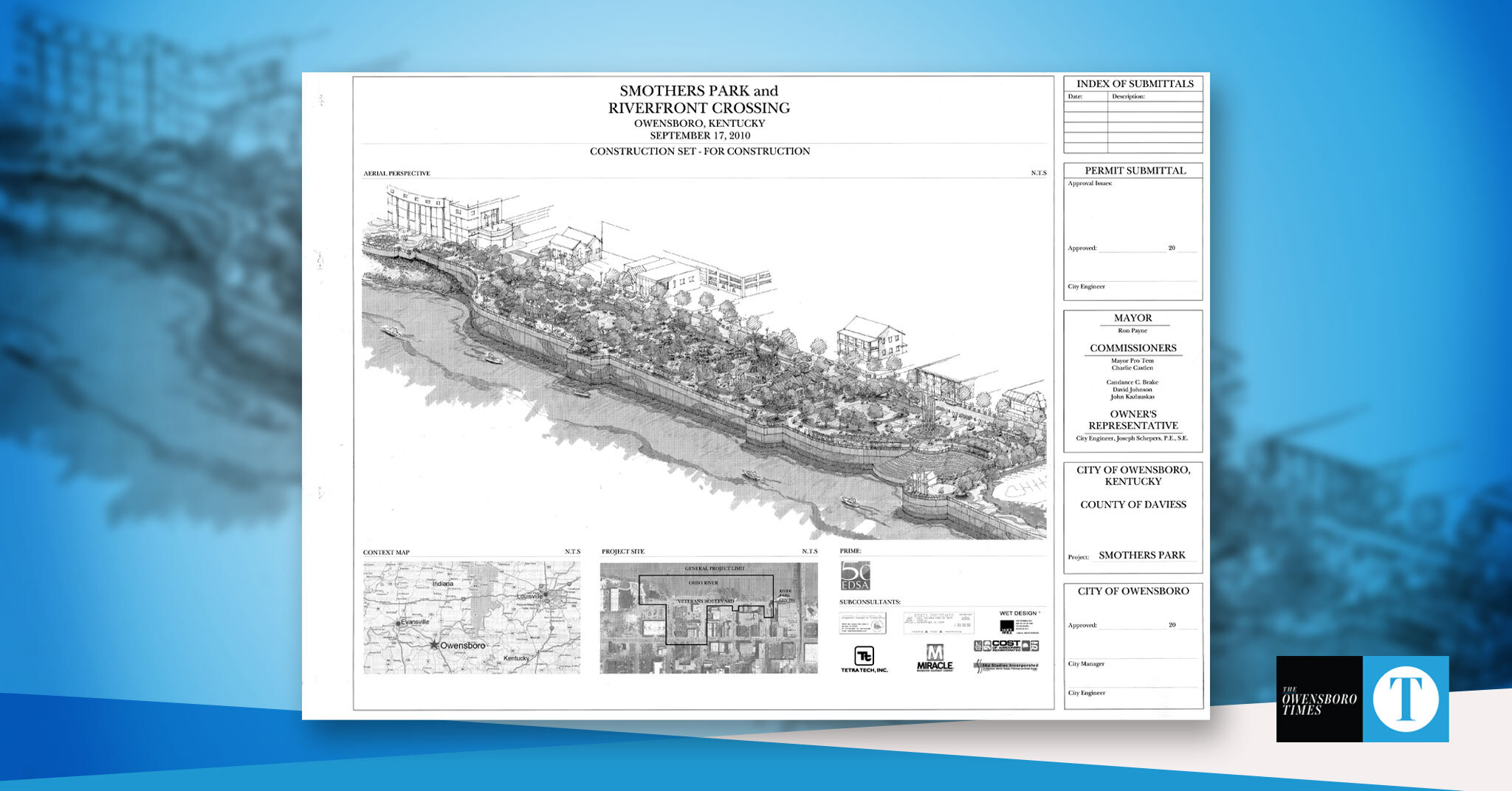
It’s hard to imagine now, but before fountains danced along Veterans Boulevard and children swarmed one of the nation’s most acclaimed playgrounds, Smothers Park was little more than a sloping bank with a modest playset and a boat ramp.
More than a decade later, the park has become the crown jewel of downtown Owensboro — a symbol of investment, vision, and transformation. And perhaps nothing captures that evolution better than the “concrete trees” holding the riverfront together — literally and figuratively.
A revolutionary redesign
The reinvention of Smothers Park began around 2007, led by then-Mayor Tom Watson and supported by a $40 million earmark from U.S. Sen. Mitch McConnell for construction of the initial retaining wall.
Looking back, Watson said the City’s preparedness and political relationships played a key role in securing the funding.
“We already had a plan in place,” Watson said. “Other cities weren’t ready. So I asked them if we could take their front-end money, and they could have our back-end money. They agreed, and we got started.”
Ron Payne was elected mayor in 2008 and oversaw the park’s development into what it is today.
That early momentum allowed Owensboro to leap ahead in developing what would become one of America’s top-rated children’s parks. The total public investment was around $80 million, with additional private development pushing total downtown investment into the hundreds of millions.
“This park is a lot like a loss leader at a grocery store,” said Assistant City Manager Lelan Hancock. “It may not directly generate revenue, but it brings people in. Once they’re downtown, they’re shopping, eating, staying at hotels. That’s the return.”
Function behind the form
Among the park’s most misunderstood — and now most iconic — features are the oversized concrete trees that tower throughout the playground.
“When they went up, people thought they were just weird-looking art installations,” Reggie Helm, a local musician who wrote a satirical song titled “Concrete Trees,” said in a previous OT interview. The song, which poked fun at the city’s spending, briefly went viral and sparked heated public debate.
But those trees are far from ornamental. According to Hancock, they’re essential to the playground’s structural integrity and purpose.
“They connect the elevated walkways and support the entire ADA-accessible structure,” Hancock said. “If you’re in a wheelchair, if you have any kind of mobility challenge, you can go with your child, play with your child, and access every part of that playground.”
Hancock said the city worked closely with Miracle Playground and Cost of Wisconsin, a specialty manufacturer that builds larger-than-life, life-like structures. The design incorporates elements inspired by the Ohio River — from fish and cattails to log-like tree trunks — all with intentionality.
“It was revolutionary,” Hancock said. “Not just in how it looked, but in what it allowed us to offer. Accessibility. Inclusion. Imagination.”
The legacy beneath the surface
Beneath the park’s polished surface is a massive structural feat. Coffer dams and sheet piling were installed along the riverbank to prevent erosion and reclaim land that had slipped away over decades. The bank was rebuilt, utilities were installed, and the playground, fountains, and walkways were constructed on top.
“There’s more than meets the eye,” Hancock said. “And that’s part of what makes it special.”
Owensboro now maintains a dedicated replacement plan to ensure the park — and others like it — remain in top condition.
“Our parks are well-maintained because they’re heavily used,” Hancock said. “That’s a good problem to have.”
From controversy to community pride
Helm’s parody song once caused enough stir that local radio stations pulled it from rotation under pressure. But over time, even he grew to appreciate the park’s broader value.
“Everybody who used to complain about it is okay with it now,” Helm said. “It brings people together. It’s a draw. Kids go crazy for it. And in the end, I guess that song brought awareness.”
Watson agrees, saying he continues to field compliments from visiting officials and business leaders.
“They ask, ‘How’d you do it?’” Watson said. “And I tell them — it took vision, planning, and political will. But mostly, it was this community that built it and believed in it.”
He noted the park has been a catalyst for economic development, sparking nearby projects such as the convention center, new hotels, restaurants, retail shops, and the river walk.
“There used to be nothing downtown,” Watson said. “Now it’s full of life. And Smothers Park — that was the spark.
As Smothers Park approaches its 14th year since reopening, it stands not only as a symbol of revitalization but as a reminder that bold moves, even controversial ones, can pay off when grounded in purpose.