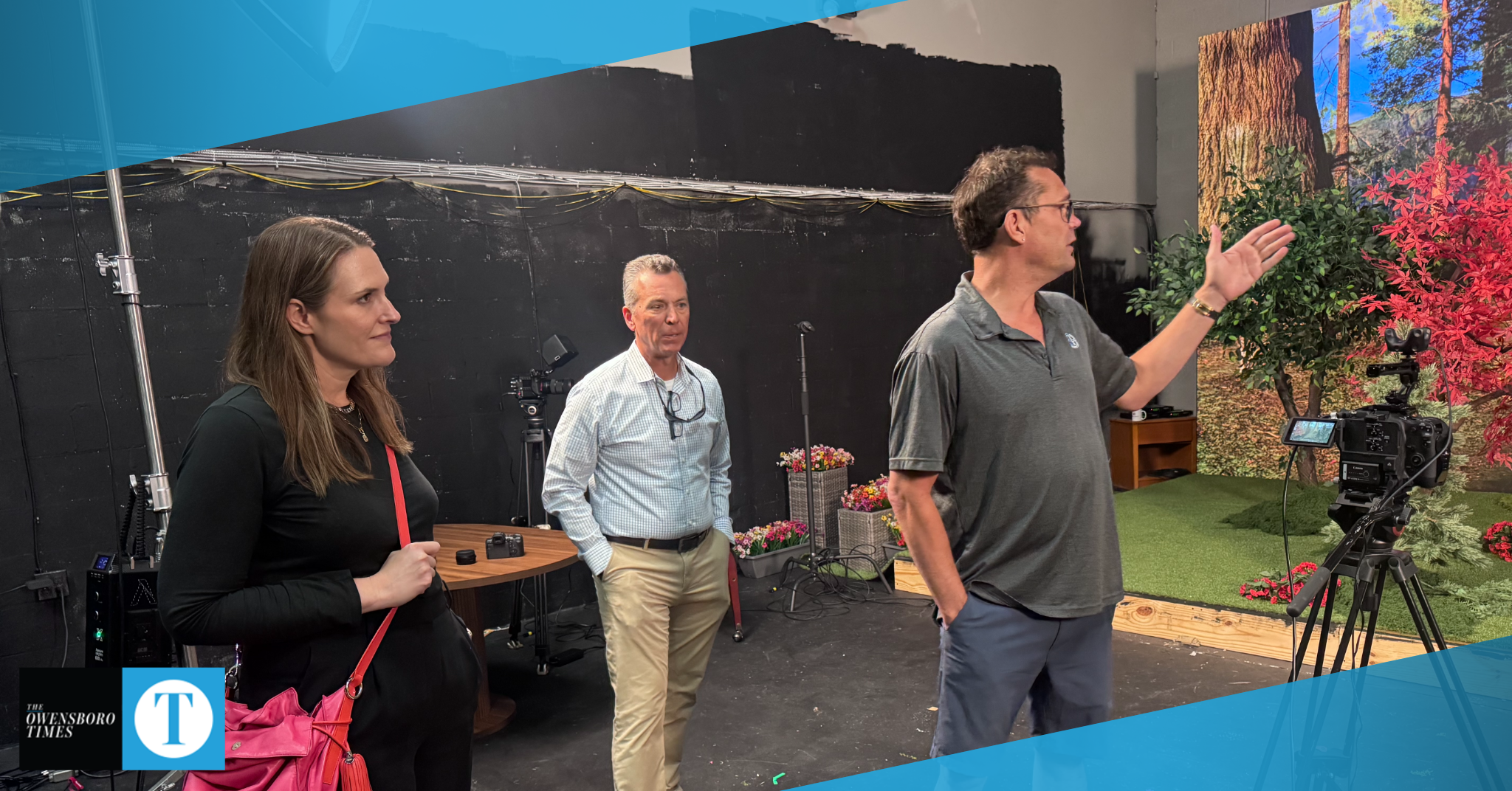
The Kentucky Film Office is looking to build on Owensboro’s growing reputation as a filmmaking destination, with state leaders pointing to the city’s soundstage, workforce development efforts, and community support as key assets in attracting more productions to Kentucky.
Meg Fister, executive director of the Kentucky Film Office, visited Owensboro this week to meet with local leaders, investors, and partners involved in the region’s growing film industry.
“Owensboro has so much film going on,” Fister said. “We have the Kentucky Sound Stage, and we have people doing a lot of work for economic development in the creative sector. I’m here to help uplift those efforts at the state level.”
During her visit, Fister met with State Rep. Suzanne Miles, the Greater Owensboro Economic Development Corp., and other local stakeholders to discuss ways to strengthen Kentucky’s entertainment industry and increase collaboration between state and local partners.
A Louisville native, Fister spent years working as a film and television producer for Warner Bros. and NBCUniversal before returning to Kentucky. She became executive director of the Kentucky Film Office in February after discovering the state’s growing role in attracting film productions.
She said Owensboro has already positioned itself as one of Kentucky’s major filmmaking hubs.
“We have infrastructure here, we have crew here, we have an engaged municipality that wants to make it accessible for production, and we have community interest,” Fister said. “Owensboro was steps ahead of that, so they’re a key partner with the film office.”
Fister said Kentucky’s biggest challenge has been visibility rather than capability.
“People had heard around the nation that Kentucky had a great incentive, but they just didn’t really know anything about it,” she said.
To address that, the Kentucky Film Office is launching a new website, online application system, and production database designed to make the state’s incentive programs more transparent and accessible.
She also believes Kentucky offers advantages that many larger film markets cannot.
The state’s diverse landscapes, centralized geography, affordability, and accessibility allow filmmakers to create a wide variety of settings without traveling long distances, she said. Producers can also work directly with local and state officials much more quickly than in larger states.
“Time is money when it comes to creative industries,” Fister said. “I think Kentucky should be king of independent filmmaking.”
She described Owensboro as offering the amenities of a larger city while maintaining the charm and flexibility of a smaller community.
“It’s really exciting what Owensboro has to offer because it has all the amenities of a big town, but it’s also charming and small and can double for any kind of rural town,” Fister said.
One of the city’s biggest assets is the Kentucky Sound Stage, which Fister said fills an important niche in the state’s film infrastructure.
“Not a lot” of facilities like it exist in Kentucky, she said.
“It’s unique and special,” Fister said. “It’s not one of the huge Class A stages that are often too expensive for productions. This is exactly the size and price point our independent filmmakers are excited about.”
The facility includes multiple permanent and adaptable sets, editing suites, a live event venue, and a virtual production stage featuring one of Kentucky’s largest LED volume walls.
Executive Director Jeremy Winton said the soundstage has continued expanding since opening, adding partnerships with colleges to help develop Kentucky’s future film workforce.
Kentucky Wesleyan College recently established a film and television program and has begun holding classes at the facility. Western Kentucky University also recently brought 20 to 30 students to Owensboro to produce a film.
“The most exciting thing is getting the students involved,” Winton said. “We’re developing that workforce going forward.”
Winton said one of the biggest concerns he hears from production companies is Kentucky’s lack of film infrastructure.
“Well, we do,” he said. “We’re starting to, and we’re going to keep developing people.”
The soundstage also hosts concerts, comedy shows, commercial productions, and community events. Everything filmed at the facility is recorded for potential future distribution.
Winton announced the Kentucky Sound Stage plans to launch its own streaming platform in November, featuring Kentucky-focused movies, television shows, and other original content.
He also said several premium productions are already lined up for the platform, including a television series expected to begin filming in Owensboro later this summer.
The state’s entertainment incentives are also expanding.
Fister said the recent passage of Senate Bill 324 broadens Kentucky Entertainment Incentive eligibility beyond feature films and television programming.
The program now includes commercials, news-style video productions, and video games.
“Not only does that capture more business here, but it’s to grow our workforce so people are employed longer throughout the year,” Fister said. “Commercials are a huge reason people in Los Angeles have continued to work, and I want that option for Kentucky.”