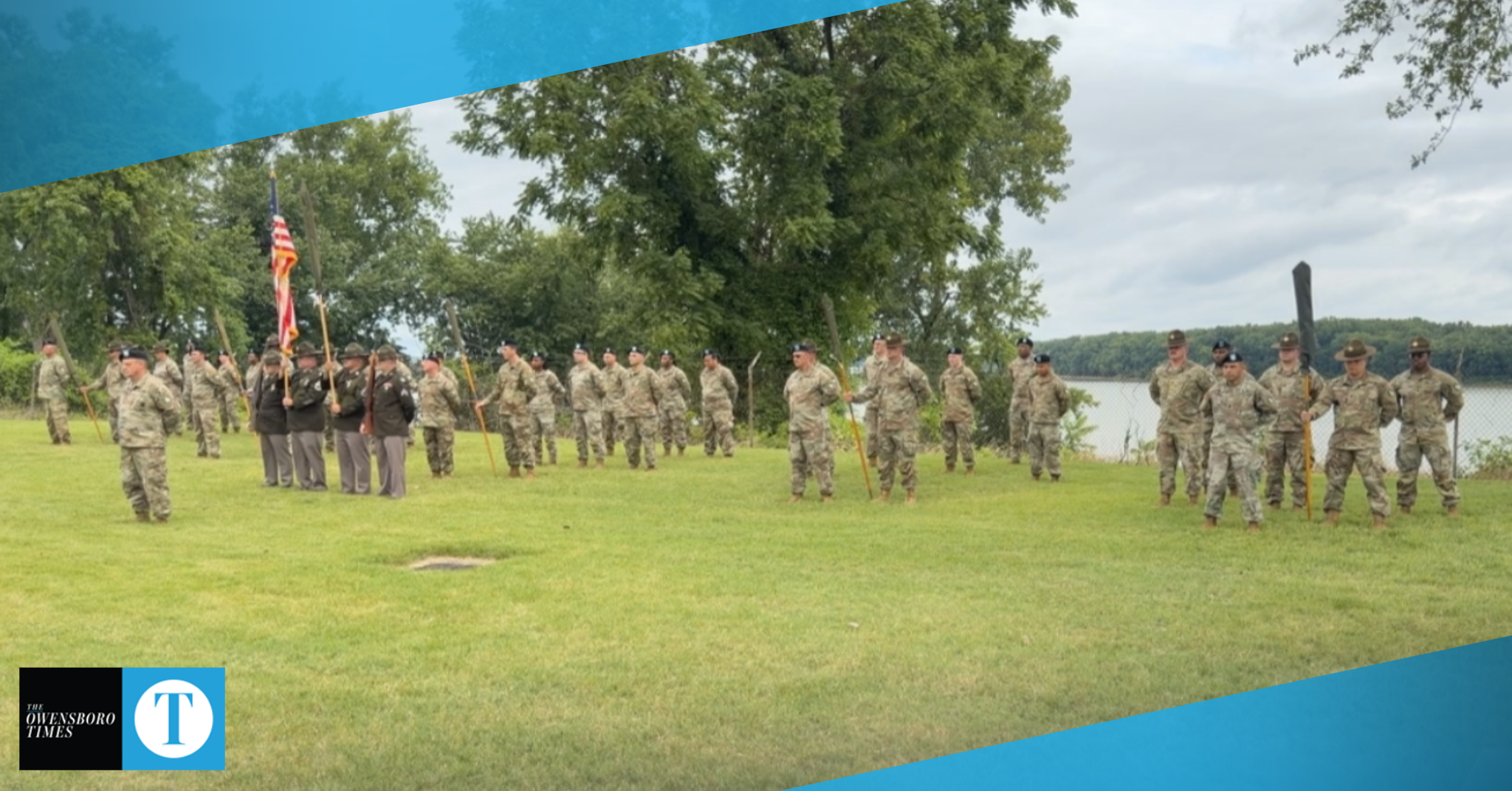
The 1st Battalion, 398th Infantry Regiment formally ended its chapter in Owensboro on Saturday as Army leaders cased the unit’s colors and inactivated the battalion as part of a broader military force realignment.
The formal ceremony was held at the Maj. Clifford F. Riley Army Reserve Center, where soldiers, veterans, military leaders, local officials, and community members gathered to recognize the battalion’s history and legacy.
“By authority of the Department of the Army, the 1st Battalion, 398th Infantry Regiment is hereby inactivated at Owensboro, Kentucky,” an official order read. The inactivation became effective July 11.
Casing a unit’s colors is a traditional military ceremony marking a unit’s inactivation or transition. The colors represent the unit’s history, honors, and lineage and are formally rolled and placed into protective cases.
Col. Mike Broderick, commander of the 2nd Brigade, said the ceremony marked a significant moment for the battalion and the Owensboro community.
“Casing a unit’s colors is an act of routine military necessity, a deliberate shifting of banners carried out as the strategic needs of our Army and our nation require,” Broderick said. “Let us be clear: Routine does not mean insignificant.”
He said the battalion’s impact will remain long after the colors are put away.
“While the fabric of these colors may be rolled away today, the spirit, the history, and the impact of the 1st Battalion, 398th Regiment remain permanently etched into the fabric of the United States Army,” Broderick said.
According to Army historical records, the 398th Infantry was constituted in 1918 and reconstituted in the Organized Reserves in 1921. The regiment later served during World War II and participated in campaigns in the Rhineland, Ardennes-Alsace, and Central Europe.
Broderick said the regiment produced two Medal of Honor recipients, 1st Lt. Edward A. Silk and Pfc. Mike Colalillo, whose actions demonstrated the importance of courage and discipline on the battlefield.
Army records also show the regiment’s headquarters was established in Owensboro in 1959. The headquarters was ordered into active military service at Owensboro in September 1961 before returning to reserve status in August 1962.
Broderick said the battalion’s history demonstrates that the Army has continually been forced to adapt to changing battlefields. He pointed to the transition from early 20th-century warfare to artificial intelligence, drones, and rapidly changing battle spaces today.
“We find ourselves standing on the edge of a new frontier, an era of algorithmic warfare defined by artificial intelligence and invisible battle spaces that change by the millisecond,” Broderick said. “To meet these complex threats, the Army cannot remain static. We must recalibrate our capabilities. We must evolve.”
Lt. Col. Jennifer Glossinger, battalion commander, echoed that message and emphasized that the Army Reserve’s realignment should not be viewed as a retreat.
“This realignment is not a retreat,” Glossinger said. “It is a very deliberate adaptation to align our forces to the needs of the nation.”
Glossinger said the battalion has served as a pillar in western Kentucky and trained thousands of soldiers.
“The colors may be cased today, but the legacy lives on as our soldiers go forward,” she said.
Broderick said most of the battalion’s soldiers will transfer to a new command and continue carrying out the mission. He said their work includes supporting U.S. Army Cadet Command, senior ROTC, and summer training at the U.S. Military Academy at West Point and Fort Knox.
In times of crisis, Broderick said the soldiers’ wartime mission includes providing initial entry training support to transform civilians into disciplined, combat-ready soldiers.
Broderick said the 104th Training Division, the battalion’s higher headquarters, is also preparing to discontinue its mission during a ceremony next month at Joint Base Lewis-McChord in Washington.
Despite the organizational changes, military leaders repeatedly stressed Saturday that the soldiers and their mission will continue.
“The realignment changes our structure, but it does not change our heart,” Glossinger told the battalion’s drill sergeants. “You will go forward and do great things.”
Broderick also thanked Owensboro and surrounding communities for supporting the unit and its soldiers throughout the years.
“Though these colors are cased today, a piece of the 398th’s heart will always remain rooted right here in the soil of Daviess County,” he said.