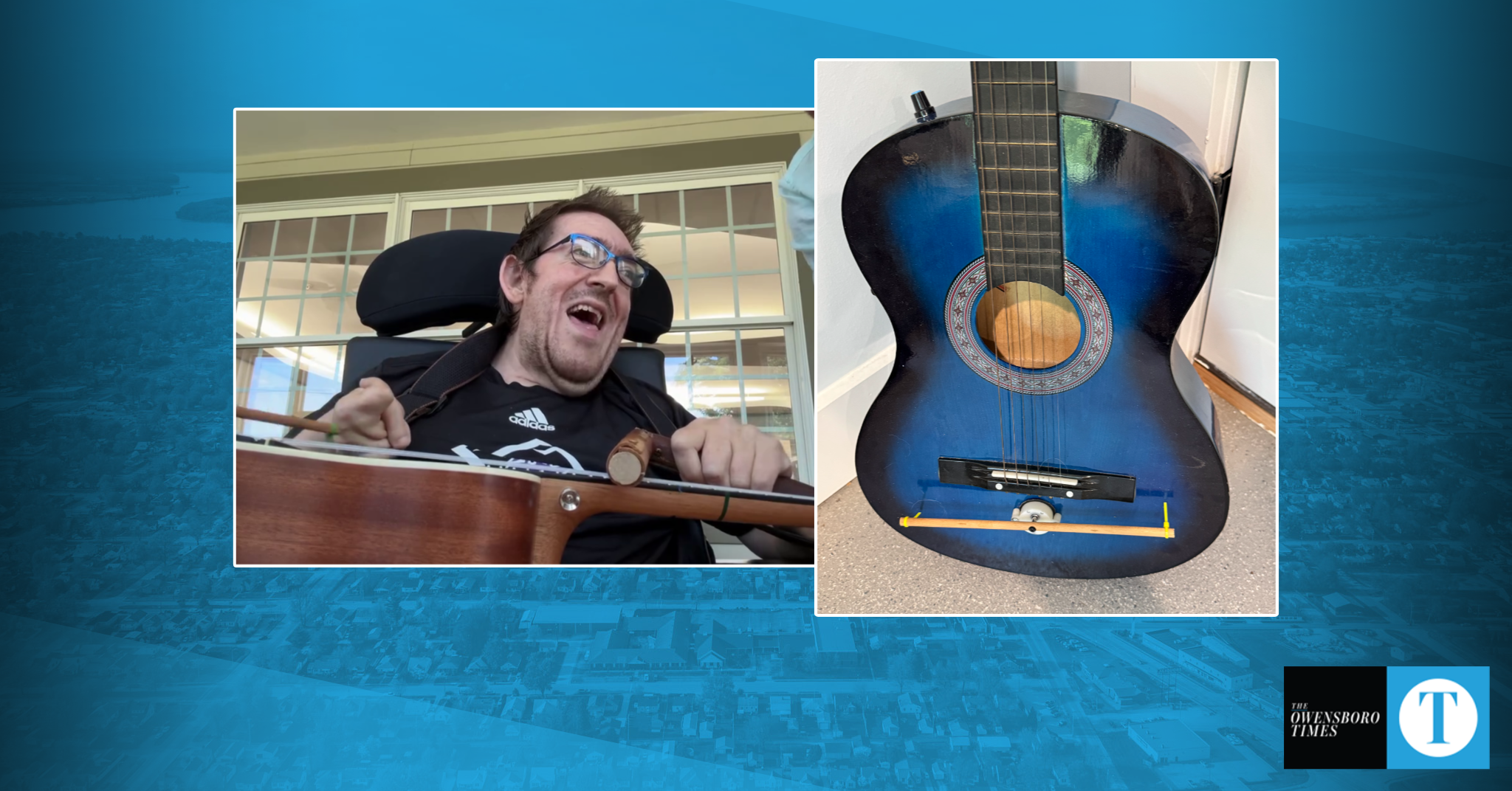
For years, Randy Lanham has looked for ways to remove barriers that keep people from experiencing the joy of making music. Now, he and his brother, Todd, believe they have created their most promising solution yet.
The Daviess County brothers have developed a patent-pending auto strummer for acoustic guitars and ukuleles designed to help individuals with physical limitations, disabilities, or other challenges play stringed instruments more easily.
The battery-powered device, which is built directly into the instrument, automatically strums the strings at an adjustable speed, allowing users to focus on forming chords rather than coordinating a strumming motion.
Lanham said the idea grew out of his work with individuals with special needs.
“I’ve just been working more with folks with special needs over the past couple of years,” he said. “I realized there could be something useful that would let people play music and not have to worry about the strumming part.”
The project began after Lanham worked with a young musician named Josh, who was fascinated by playing a mandolin but needed assistance changing chords. Lanham later gave him an open-tuned ukulele that simplified playing, but he continued searching for an easier solution.
His first attempt involved a foot-pedal-operated strummer.
“It just didn’t work as well as I hoped,” Lanham said. “The timing was difficult. I wanted something where I didn’t necessarily have to be there every time to help.”
Eventually, he turned to a simple motor-powered design.
“I kept thinking there are motors that spin,” he said. “Why couldn’t something like that work?”
Finding the right components took months of trial and error, from testing different motors to deciding between plug-in power and batteries. The brothers eventually settled on a compact, battery-powered design with an adjustable speed control that can match different musical tempos.
The device is built entirely inside the body of the instrument, leaving only the control switch and battery access visible.
Lanham said each instrument is custom-built to meet the user’s needs. The placement of the power switch can be adjusted depending on whether someone plays right-handed, left-handed, on their lap, or in a traditional position.
For some players, the instruments can also be open-tuned, allowing chords to be made with simple finger placement, a slide, or specially designed chord-making devices the brothers have created.
“It really depends on the person,” Lanham said. “They’re almost custom-built.”
While the invention was originally designed with individuals with disabilities in mind, Lanham said it could also benefit people with arthritis or other mobility limitations.
The brothers have already built and distributed one of the first prototypes to Josh and hope to begin working with more musicians as interest grows.
Lanham recently received patent-pending status for the invention, though he said financial success was never the driving force.
“Making money is not the point,” he said. “The main thing is helping everyone be able to enjoy playing music.”
Lanham describes the invention as “God-inspired,” saying he felt called to develop something that could make music accessible to people of all abilities.
“I feel like God gave it to me for a reason,” he said. “I want people to be able to use it.”
The auto strummer is not Lanham’s first accessibility-focused invention.
After watching a deaf student experience the vibrations of an upright bass during a Bluegrass Music Hall of Fame & Museum visit, he developed a speaker-equipped chair and wearable vibration system that allows individuals with hearing impairments to feel the music they are playing through electric instruments.
Although that project remains in its early stages, Lanham hopes the launch of the auto strummer could generate interest in both ideas.
He also sees potential applications beyond music education, including hospitals and rehabilitation settings, where patients could use the simplified instruments as a creative outlet during recovery.
“I think it’s going to take us a while to figure everything out and continue making it easier for people to learn,” he said. “We’ll continue to tweak it and change it, and we’ll figure it out as we go.”
The brothers currently build the instruments in Todd Lanham’s workshop and are accepting inquiries from anyone interested in purchasing or learning more. Because each instrument is customized, they plan to build them as orders are received rather than producing them in large quantities.
More information is available at High Hopes Music or by emailing [email protected].