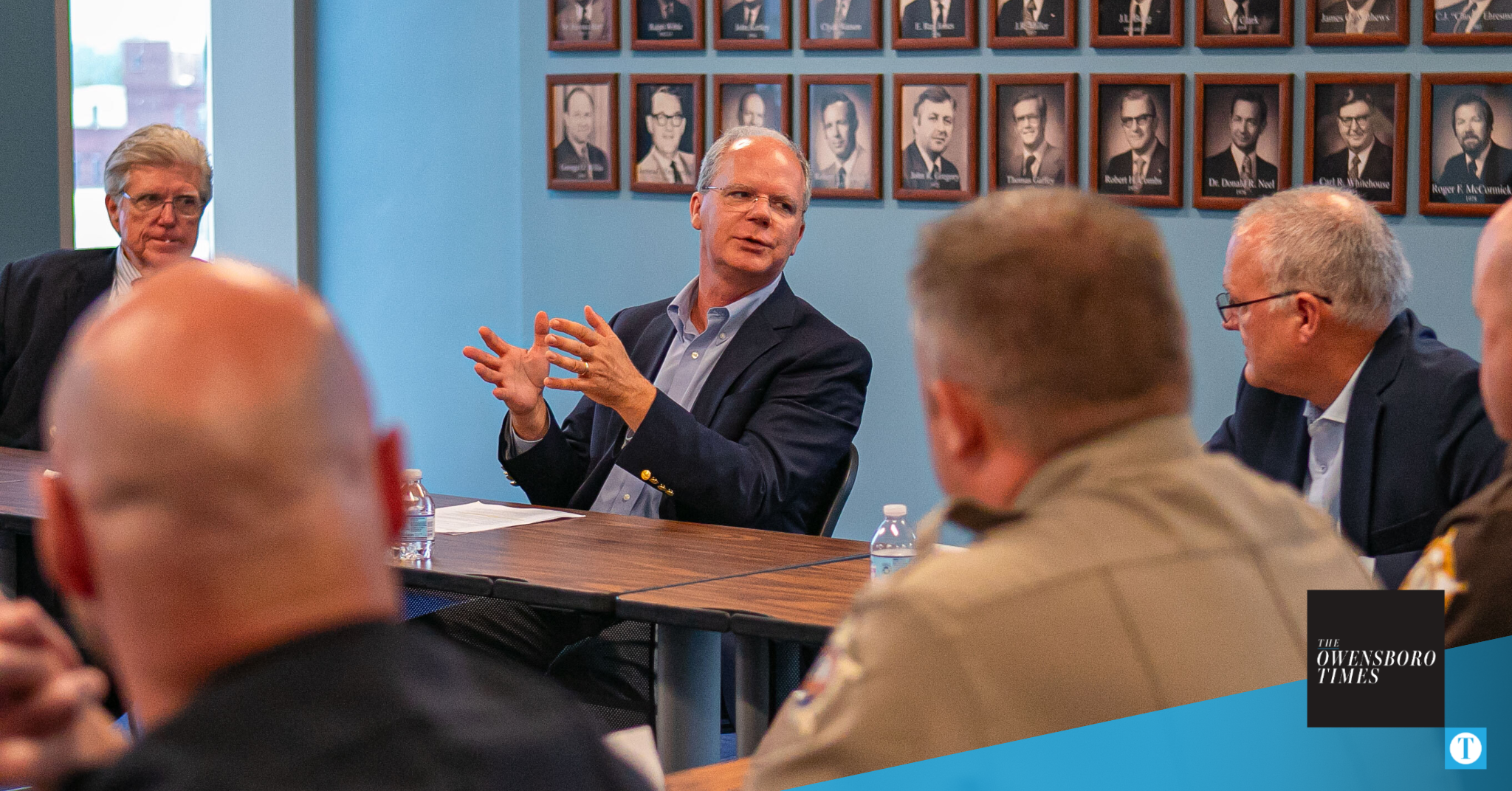
U.S. Congressman Brett Guthrie was in Owensboro on Tuesday to meet with area legislators and law enforcement officials for a roundtable discussion on how Congress can partner with state and local agencies to combat illicit drug trafficking and the overdose crisis.
While no specific action plans were made, those participating said the roundtable was important because it started the conversation to get leaders at all levels on the same page.
“As we shape policy at the federal level, this information is valuable because we learn what’s going on on the street and what people are experiencing in their communities,” Guthrie said. “For instance, we talked about other synthetic drugs that I need to go back and do some research on that are available and some convenience stores. That’s something that I know about, but I haven’t really heard about how pervasive they are until today.”
State Senator Gary Boswell had strong opinions about such drugs, which he calls “gas station products” due to their prevalence and availability there. He specifically pointed to kratom and products that have THC (the main psychoactive compound in marijuana).
Boswell said those products are essentially gateway drugs for youth, and added that the punishment for juveniles committing crime — whether it be drug-related or otherwise — is not serious enough.
“To me, one of the most important things we’re gonna have to look at is early intervention,” he said of the state legislature’s role in the battle against drug use. “Our young people are getting hooked on these products. And not only that, a lot of our young people are selling these products on the street, and they’re making a lot of money doing it. And unfortunately, because they’re juveniles, there’s not any serious penalties.”
Boswell added, “The question I have is how do they get to the point where they’re taking something with fentanyl. They get there because they started out on low-level drugs, and they move up higher to get to the point where they’re taking something that’s got fentanyl in it. We have to get the message out to these young people that you take some of these substances, but you don’t know where they came from and you may die.”
Sheriff Brad Youngman noted that fentanyl is one of the most talked about drugs in recent months, but said there are all manner of drugs being trafficked.
“One thing I think we shed some light on was people tend to ask us ‘What’s the big drug right now?’ Because for years drugs went in cycles — it was cocaine, it was crack, it was heroin. The answer is right now, fentanyl is the scariest, but the truth is we’re seeing everything. It’s all back, and it’s everywhere,” he said. “I think that that was maybe one of the bigger messages that we were wanting to send up to Washington, is that if it’s like this in Western Kentucky it’s probably like this everywhere.”
Boswell and State Rep. DJ Johnson both said there are some bills that will likely be filed in 2024 to address the issues, but none are ready for public discussion at this time.
Another of the more pressing issues discussed was how criminal cases are handled by the court system.
One example given was how an investigation that took more than a year resulted in an arrest, but the suspect bonded out of jail the same day. Law enforcement officials said it can be discouraging to spend so much time and effort to get a criminal off the street only for them to be released almost immediately.
“I would certainly understand if I was a police officer and arrested someone and saw them out just a few hours later how that would be frustrating,” Guthrie said. “Those are things that we heard today that we need to fix.”
Similarly, the speed by which cases are handled varies widely due to a number of factors. For example, a suspect could be facing multiple “first offense” trafficking charges despite being arrested two or more times for the same offense because the first case has not been resolved before the second or subsequent arrests.
Daviess County Sheriff Brad Youngman said no one at the roundtable was placing blame anywhere, but rather shedding a light on what needs to be addressed.
“I think the judges get unfairly targeted in a lot of these frustrations,” he said. “There’s not one reason why one criminal case falls apart on its way through the criminal justice system versus another one where someone gets serious time. A lot of times it’s because of the plea negotiation process or because of something a defense attorney found that he or she can use.”
At the heart of all the discussions was how to battle the drug epidemic by not just cracking down on criminals but also providing support for addicts.
“We’re trying to get people more into rehab, instead of everybody going to jail,” Guthrie said. “I wish I could say this person that 100% always belongs in jail and this person 100% always goes into. It’s a gray area, and that’s what we need to have flexibility in the system for those decisions to be made.”
One of the bills Guthrie is working on at the national level focuses on rehab services.
“In my mind, there are people who may have criminal behavior because of their addiction,” he said. “If you fix their addiction, the criminal behavior goes away. There are some people that are not addicted, they’re just pure traffickers, and those people absolutely belong in jail.”