This article was first published in Volume 1, Issue 3 of the Owensboro Times newspaper.
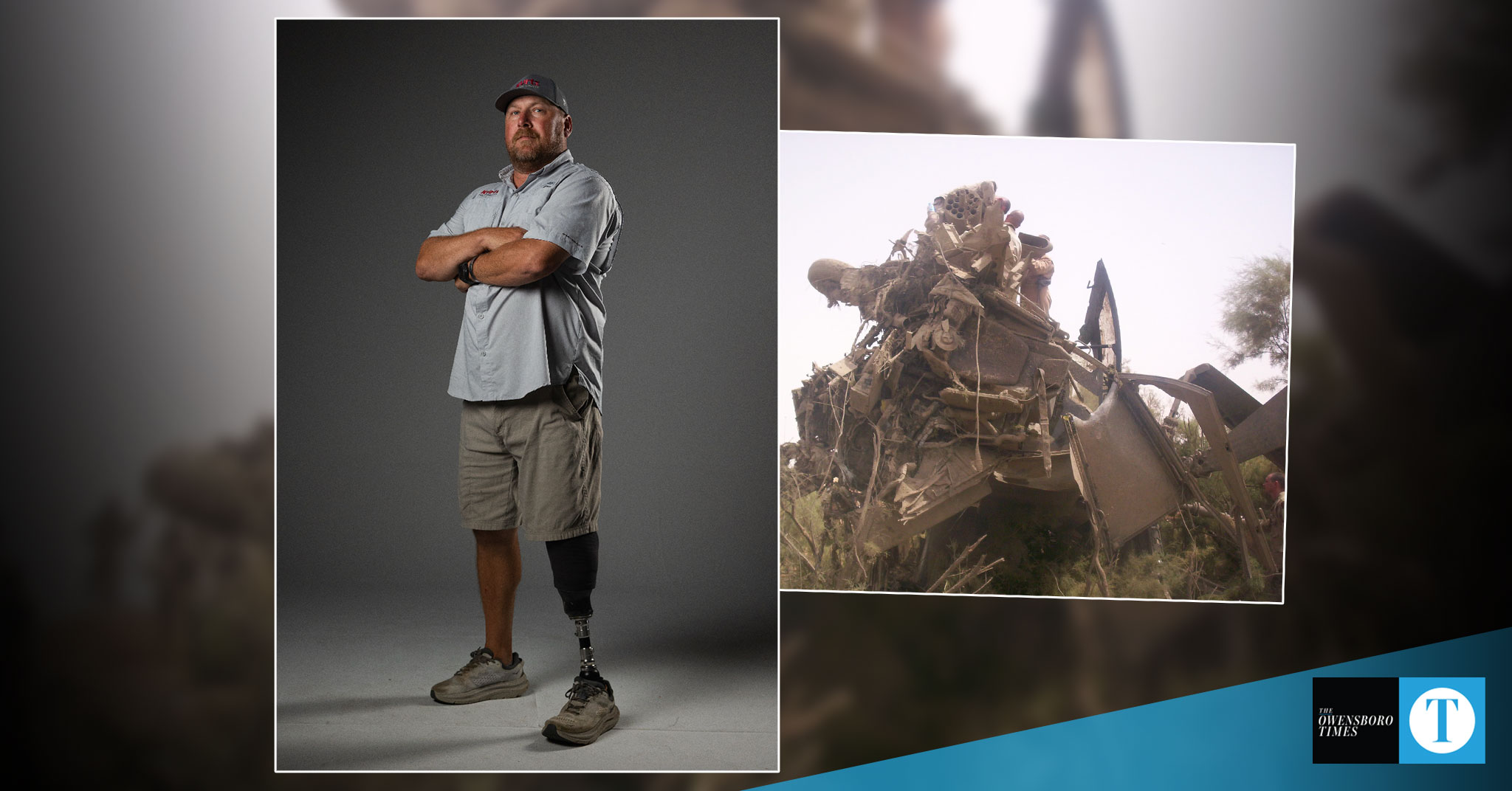
It was 125 degrees in the blistering Iraqi heat on August 12, 2005, when Clay Taylor’s Apache helicopter skimmed just a few dozen feet above the ground near Kirkuk. Circling what was believed to be a roadside bomb, Taylor and his team were performing a familiar task — securing the area until bomb techs could arrive.
Then a higher-priority call came in. Troops elsewhere were under fire. As mission lead, Taylor started punching in new coordinates. And that’s the last thing he remembers before the accident that led to his lower left leg being amputated.
His helicopter dug into the scorched dirt and was torn in two.
The impact ripped off Taylor’s Achilles tendon and drove a stick deep into his calf. When the dust settled, the cockpit was nearly gone, and he was lucky to still be alive.
“There was only this much of my seat left,” he said, holding up his hand to show a space no bigger than a license plate. “How I survived is an absolute miracle.”
From Owensboro to Iraq
Taylor grew up in Owensboro and graduated from Owensboro Catholic High School, where he played soccer. He didn’t initially plan on joining the military. In fact, his first attempt was mostly about paying for school.
“I thought I was done playing soccer after high school,” he said. “I was going to join the National Guard right then. But I had some buddies at Georgetown University playing, so I went and played one more year. After that, I knew for sure I was done, and I needed a way to pay for school.”
That’s when Taylor joined the Owensboro-based National Guard unit, initially serving as a tank driver. He eventually transferred to the University of Kentucky and then to Eastern Kentucky University, where he completed ROTC and earned a military science minor.
In December 2002, Taylor received his commission and transitioned from tanks to helicopters. Just before finishing flight school, word came down: his unit was being deployed to Iraq.
It was a new era for the American military. Taylor joined in January 1999, at a time when few U.S. troops had deployed since Vietnam. But everything changed after 9/11.
“When I joined, being deployed wasn’t something you thought about. But by the time I graduated flight school, things had ramped up,” he said. “We trained at Fort Dix for about six months and deployed to Iraq in late 2004.”
Flying low, living high-risk
Based out of Tikrit — Saddam Hussein’s hometown — Taylor served as a platoon leader and Apache pilot. He was responsible for four aircraft and roughly 10 soldiers.
Most days were a mix of long hours and tense calm. Their primary missions were reconnaissance, convoy security, and supporting ground troops during firefights. Many flights were low-altitude sweeps along desert highways, searching for signs of IEDs.
Some days were quiet. Others were chaotic. But every day carried risk.
“You could go from monotony to sheer intensity in a matter of seconds,” he said. “The heat made everything harder. The air was so thin that flying became much more sensitive — the margin of error was incredibly small.”
By the summer of 2005, Taylor’s unit was preparing to rotate out. Their replacements were on the way. Taylor’s injury came just weeks before they were scheduled to hand over operations.
“That day, we were flying a routine recon over a known trouble spot,” he recalled. “We spotted what looked like a roadside bomb. So, we circled to secure the area. I was punching in new coordinates to respond to another call when we went down.”
The heat, the altitude, and the low flight pattern combined to create a perfect storm.
“We think the helicopter just dug in,” he said. “The front ripped off. I was out of it (mentally), but my copilot and the team in the other aircraft pulled me out. I had broken ribs, lacerations, and that stick in my leg. But it was my foot that was worst.”
Crash, survival, and recovery
Taylor was medevacked to a small hospital in Tikrit, then to a larger base. Surgeons amputated just above the ankle. He was sent to Germany, then Walter Reed Army Medical Center in Washington, D.C. Along the way, doctors realized they needed to take more of the leg.
“They went up another four inches to help with mobility and fitting the prosthetic,” he said. “It actually made things easier down the road.”
At Walter Reed, the severity of Taylor’s injuries became clearer, but so did his good fortune.
“I caught a really bad infection from the stick that was lodged in my shin,” he said. “That was the most dangerous part. It was a close call. They had to scrub the wounds every day. That could’ve taken me out.”
Despite the circumstances, Taylor never let bitterness take hold.
“I was 25. I hadn’t really figured out what I was going to do with life yet,” he said. “So, emotionally, it was easier than it would’ve been for someone with kids or a long career. I’ve always been a guy who just deals with things. You adapt and move forward.”
At Walter Reed, surrounded by others with injuries far worse, he found perspective.
“My roommate had his head nearly blown off and was throwing up every night from vertigo,” he said. “It’s hard to feel sorry for yourself when you see stuff like that. I felt lucky.”
Taylor was up and walking on a prosthetic within weeks. Despite a broken foot on his good leg, he pushed through rehab with determination. By Christmas, just four months after the crash, he felt mostly back to normal.
By April 2006, he was officially discharged.
Life, love, and resilience
What came next was life. He got engaged and then married to his longtime girlfriend Renee, came back to Owensboro, and started figuring out what his civilian future would look like.
“I worked at Texas Gas for a little while, but it just didn’t fit me,” he said. “I had a good relationship with the people at Kurtz Auction & Realty, and I gave a talk at Rotary that led to a conversation. They thought it might be a good fit — and so did I.”
In the two decades since the crash, Taylor has quietly carved out a successful career and an even more meaningful life. He and Renee are now parents to two daughters — Cameron, a senior at Owensboro Catholic High School, and Mazie, a sophomore.
They’ve grown up with a father who has never used his injury as an excuse — a fact he hopes they’ve absorbed, even if he doesn’t talk about it much.
“I’m not a ‘look at me’ kind of guy,” Taylor said. “I try to teach more by action than by talking. I show up, do what I say I’ll do, and take care of the things that matter. That’s what I want them to learn.”
While Taylor doesn’t speak publicly often, he has made exceptions, particularly when he can talk one-on-one with someone who’s recently suffered an amputation.
“A few times I’ve talked to kids who lost a limb, maybe in a four-wheeler accident or something like that,” he said. “I prefer that setting. I’m not trying to be a motivational speaker. I’m just trying to say, ‘Hey, I’ve lived with this for 20 years. It’s not always easy, but you can live a full life.’”
Those conversations — quiet and honest — mean more to him than any stage or spotlight ever could.
“There’s a fine line between sharing your experience to help someone and making it about yourself,” he said. “I never want to cross that line.”
Taylor’s military service shaped much of who he is today, but it’s the people who surrounded him after the injury that he credits with his recovery.
“My mom was there from the beginning, and Renee never left my side,” he said. “My friends, my family, someone was always there. I probably didn’t realize how much that mattered at the time. But looking back now, as a dad, I see it more clearly.”
His mother passed away four years ago, but her presence still guides him.
“She gave everything she had to make sure I was OK,” he said. “I’d be wrong not to say that. I wouldn’t have made it through without her, and without all of them.”
Reflecting on the crash 20 years later, Taylor doesn’t focus on what he lost. Instead, he talks about how close he came to losing everything — and how lucky he was that the story didn’t end in that desert.
“Bad stuff happens every day. I’ve never been the kind of guy to dwell on it,” he said. “I had a job to do, I did it, and when things changed, I adapted. That’s just life.”
And in many ways, the military taught him how to handle that.
“In basic training, in flight school, and in Iraq — it all prepared me for that moment and for what came after,” he said. “You just do what you’ve got to do. You don’t complain. You take care of your people and your responsibilities. That’s the lesson.”
At home in Owensboro, Taylor still lives by those principles. He’s rarely late, never backs out of a commitment, and leads his family the way he led his platoon — with calm confidence and a deep sense of loyalty.
For his daughters, that means showing up. Coaching when he can. Supporting their interests. Modeling what strength and resilience really look like.
For Taylor, it means going to work, loving his family, and quietly helping others when they need him.
“I’ve been blessed,” he said. “It could have been so much worse. But I’ve had 20 years I didn’t have to have. I got married, had kids, built a career. That’s more than enough to be thankful for.”