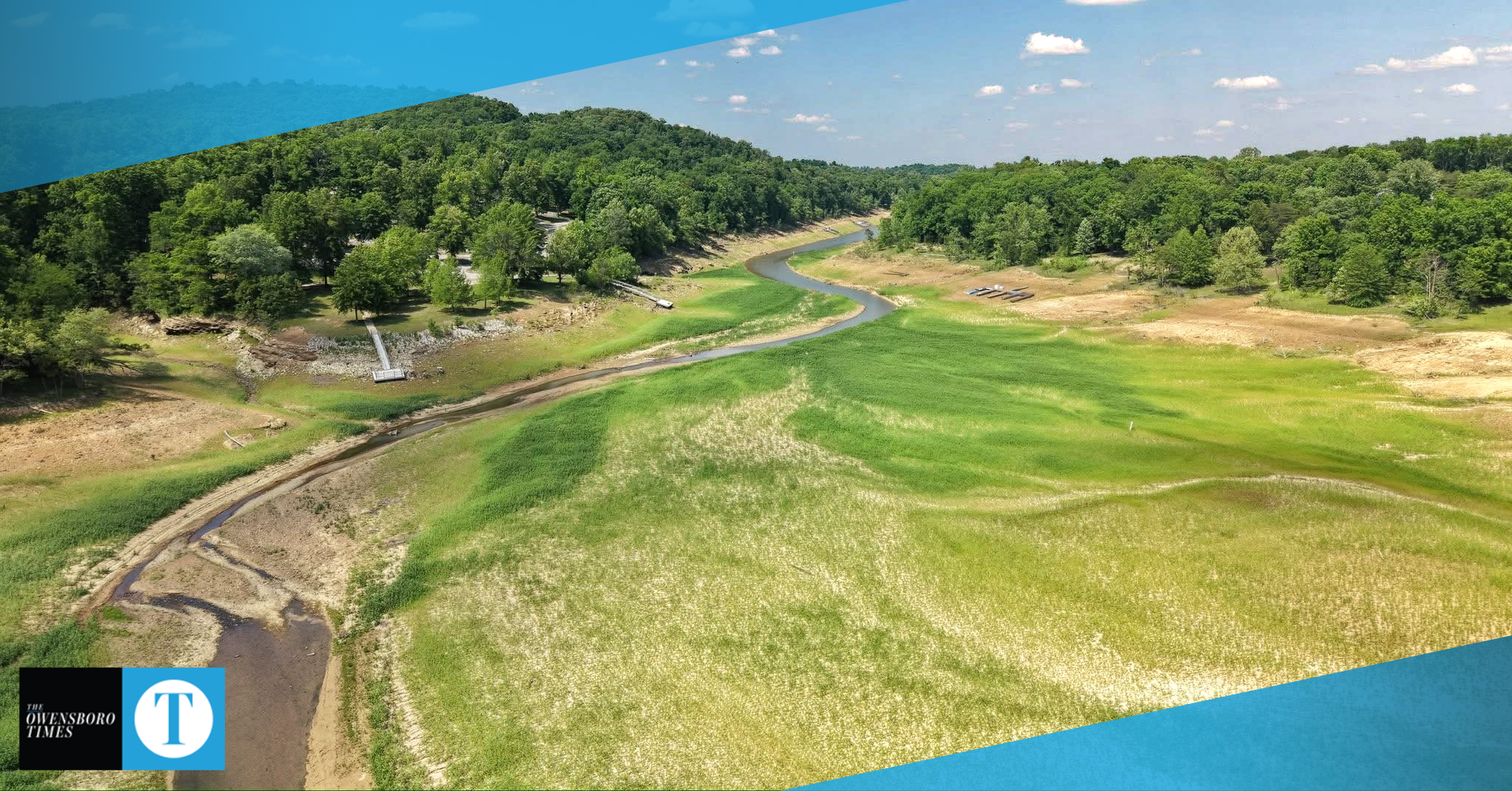
Officials with the U.S. Army Corps of Engineers said recent drought conditions across much of Kentucky were primarily to blame for historically low water levels at Rough River Lake this spring.
According to the Corps, Rough River Lake fell to an elevation of 474.2 feet in mid-May — significantly below where the lake would typically be by that point of the year.
Abby Korfhage, deputy chief of public affairs for the Corps’ Louisville District, said the lake was experiencing its lowest spring fill level in the past five years.
“According to our Water Management team, Rough River Lake [was] at the lowest level experienced during the spring fill in the last five years, falling below the second lowest by 10 feet,” Korfhage said.
The lake is currently operating under a delayed fill schedule connected to ongoing dam risk-reduction work, but Corps officials said the drought had a far greater impact on water levels than the operational changes.
“The lack of rainfall is the primary cause of the current levels,” Korfhage said. “Due to the extremely limited rainfall over the past several weeks, the lake would only be about one foot higher even under normal seasonal operations.”
Officials said that prior to this week, much of Kentucky was experiencing drought conditions ranging from abnormally dry to extreme drought, while much of Indiana and Ohio had received more rainfall this spring.
The rainfall deficit also affected other lakes across the region, particularly within the Green River and Upper Kentucky River basins.
“Rough River Lake is not unique in this situation,” Korfhage said. “Other lakes throughout the region are also currently experiencing below-normal levels.”
The Corps said it continues to operate Rough River Dam at the minimum required outflows to allow the lake to rise toward its normal summer pool elevation of 490 feet. However, officials emphasized that substantial rainfall will be necessary for that to occur.
“The lake reaching summer pool is entirely dependent on the basin receiving sufficient rainfall to overcome the current deficit,” Korfhage said.
Because drought conditions dried out the ground, officials said rainfall events are currently being absorbed before producing enough runoff to raise lake levels significantly.
“As a result, repeated soaking rains are needed to generate enough watershed runoff to raise lake levels,” Korfhage said.
The lower water levels have already created recreational impacts around the lake. Corps officials said only the Axtel and State Park boat ramps currently remain usable.
Reduced access has led to fewer boats on the water than would normally be expected this time of year, officials said. Marinas around the lake are also temporarily rearranging dock sections to maintain access for slip holders until lake levels recover.
The Corps is encouraging visitors to use extra caution while boating due to shallow areas and submerged hazards being closer to the surface than usual.
“We advise the public to plan ahead for launching and other recreational activities and appreciate the patience and understanding of the community as we navigate these drought-driven conditions,” Korfhage said.