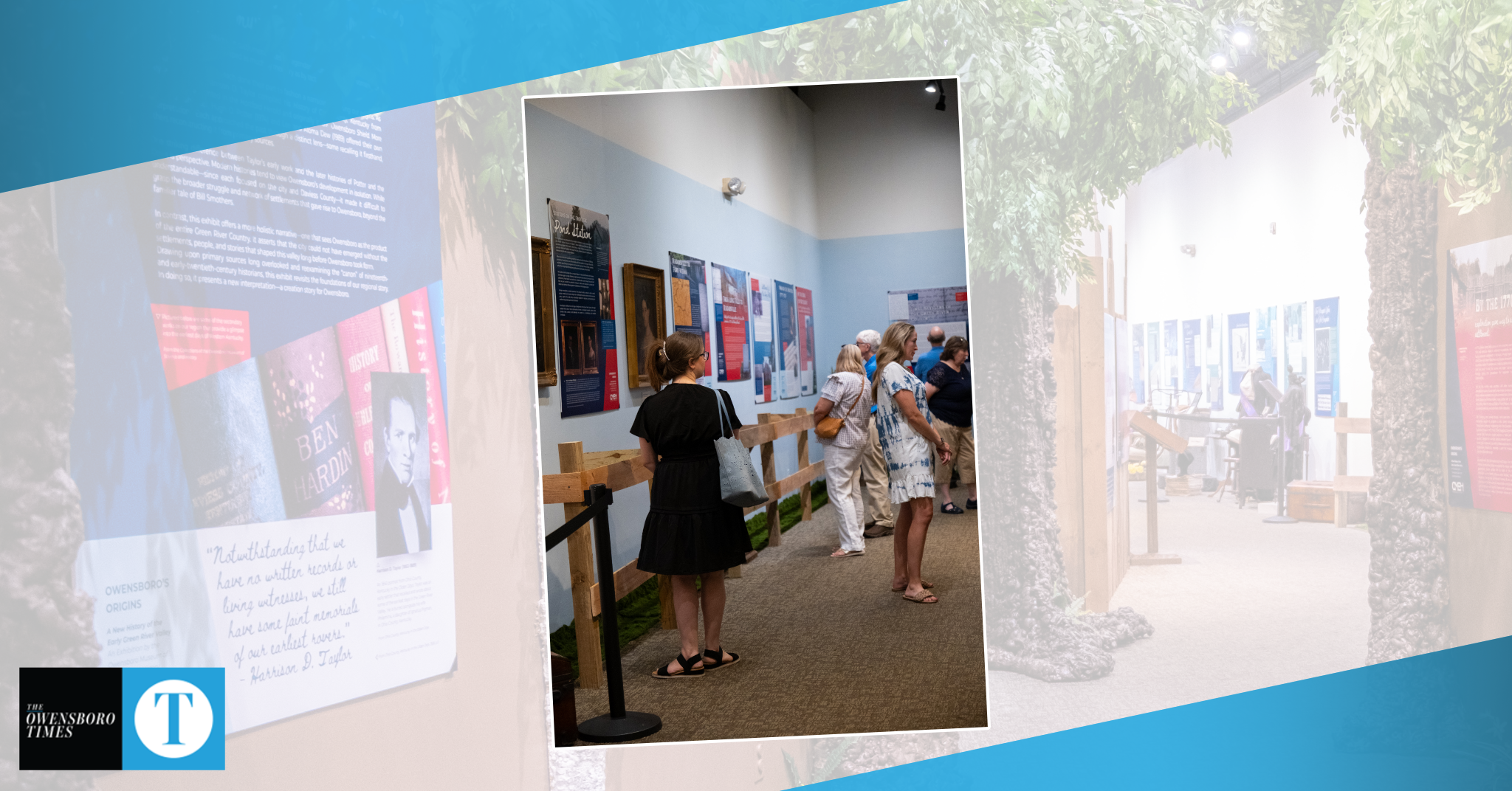
A new temporary exhibit at the Owensboro Museum of Science and History invites visitors to explore the early history of Owensboro and the surrounding Green River Valley.
The exhibit, Owensboro’s Origins: A New History of the Green River Valley, recently opened to the public and will remain on display through much of the coming year, with its duration dependent on the museum’s 2027 exhibition plans.
Executive Director Isaac Settle said the project grew out of years of personal research into Kentucky’s frontier era.
“Kentucky’s frontier and early statehood period has always been my favorite part of history,” Settle said. “I began researching the story of our region around 2020 or 2021, and as America’s 250th anniversary approached, it seemed like the perfect opportunity to turn that research into an exhibit.”
Settle said while many people are familiar with the stories of Daniel Boone and the settlement of Central Kentucky, far less has been written about how Western Kentucky developed.
“There are still many unanswered questions and plenty of topics that deserve additional research,” he said. “We wanted to help tell that story.”
Rather than focusing solely on Owensboro, the exhibit examines what Settle describes as the “Green River Country” — a loosely defined region encompassing much of present-day Western Kentucky.
He said the exhibit explains how early settlements were established primarily along the Green River because travel and settlement along the Ohio River remained dangerous until the late 1700s.
“Only after it became safer did settlers begin moving toward the Ohio River and eventually establish what became Owensboro,” Settle said. “Many of the area’s earliest settlers first lived in places such as Fort Hartford and Fort Vienna before making their way to what was then known as Yellow Banks.”
One of the exhibit’s central themes is that Owensboro’s history cannot be understood apart from the surrounding region.
“Our origin story is intertwined with the histories of many neighboring counties,” Settle said. “The county boundaries we know today didn’t exist during the frontier period, and understanding how those boundaries evolved helps explain how our community came to be.”
Settle noted that the land that is now Daviess County was previously part of Ohio County and, before that, belonged to larger counties including Hardin, Nelson and Jefferson as Kentucky’s counties were gradually divided over time.
Although the exhibit is based on years of research, Settle said bringing it to life required the work of the museum’s staff.
“The exhibit was constructed entirely by our staff,” he said. “They took my vision and made it a reality. Seeing five years of research transformed into something visitors can experience has been incredibly special, and I’m grateful for their creativity, dedication and hard work.”
In announcing the exhibit’s opening, the museum said it hopes visitors will explore the story of the region’s earliest years with “the same spirit of curiosity, appreciation and pride” that inspired the project as the nation begins commemorating the 250th anniversary of the United States.