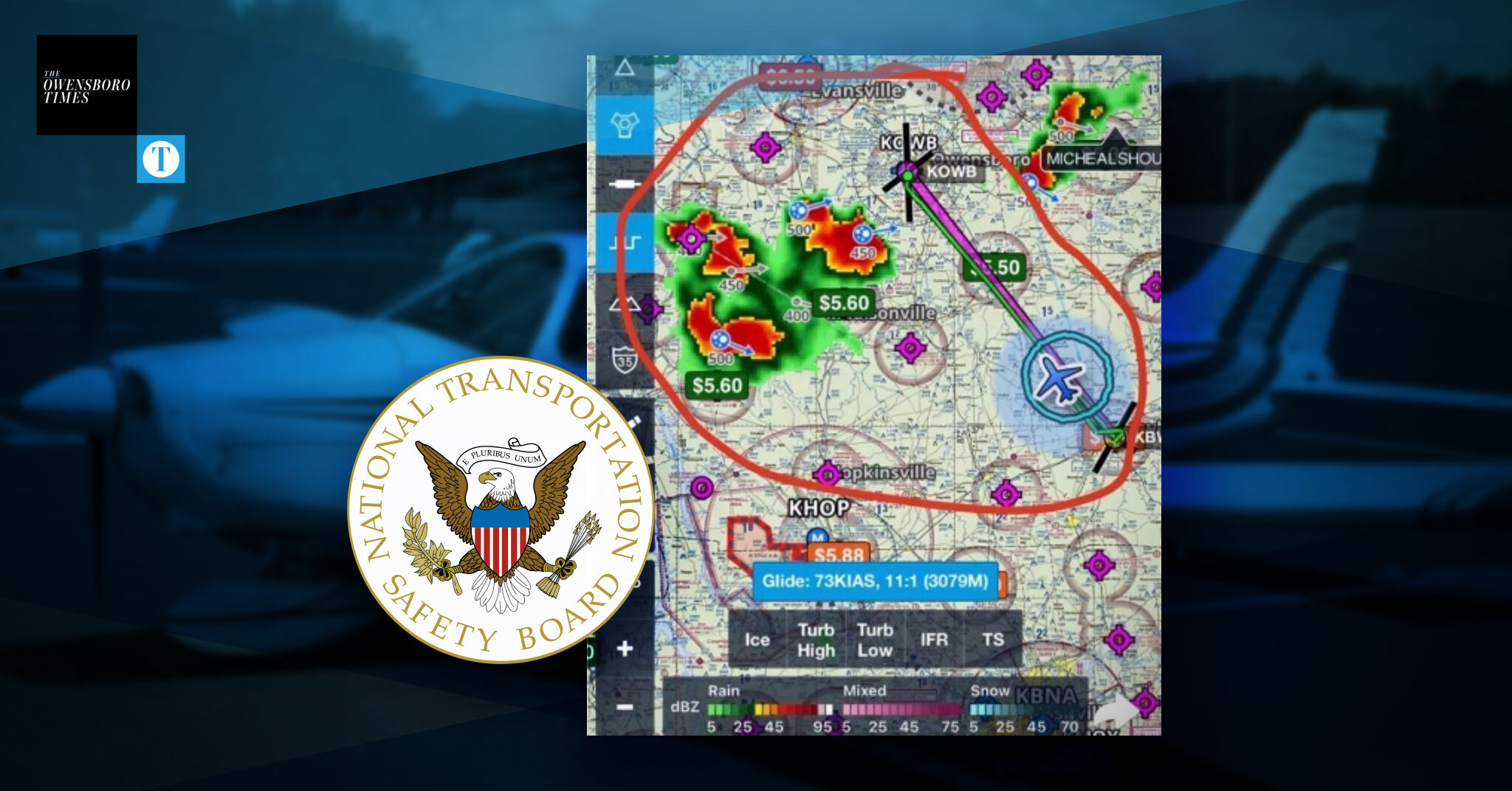
A flight instructor’s decision to continue flying into severe thunderstorms led to the 2023 crash of a small plane near Whitesville that killed both people on board, according to a National Transportation Safety Board Aviation Investigation Final Report.
The Piper PA-28-161, operated by Eagle Flight Academy, broke apart in midair on Sept. 27, 2023, while returning to Owensboro from a night cross-country training flight, the report said. The wreckage was scattered across 25 acres in a wooded, hilly area.
The NTSB said the flight was intended to satisfy the student pilot’s night training requirement before his private pilot exam and was the first time the 18-year-old student and 22-year-old instructor had flown together. Both were killed in the crash.
Investigators found the instructor had obtained a weather briefing that included an active convective SIGMET warning of severe thunderstorms with cloud tops up to 42,000 feet, hail up to 1.25 inches in diameter, and wind gusts up to 50 knots. The report said radar information the instructor posted to social media while en route was already about 10 minutes old and may have contributed to a misunderstanding of the storm’s location.
About five minutes before the accident, air traffic controllers warned the instructor of heavy to extreme precipitation nearby, according to the report. The instructor later told controllers the aircraft was “getting blown around like crazy” and then reported “pretty extreme turbulence.” Shortly after, the plane entered a descending turn and communications ceased.
The NTSB said the aircraft showed no evidence of mechanical failure, and the distribution of the debris was consistent with an in-flight breakup after the plane exceeded its structural limits.
The report identified the probable cause as the instructor’s “improper decision to continue flight into a known area of thunderstorms, which resulted in an in-flight breakup.”
Toxicology results were negative for the instructor. The student tested positive for an over-the-counter antihistamine, though the NTSB said it could not determine if he was impaired.
The agency issued a safety reminder noting that cockpit weather radar displays often lag behind real-time conditions, sometimes by as much as 15 to 20 minutes, and pilots should not rely solely on those images when flying near severe weather.