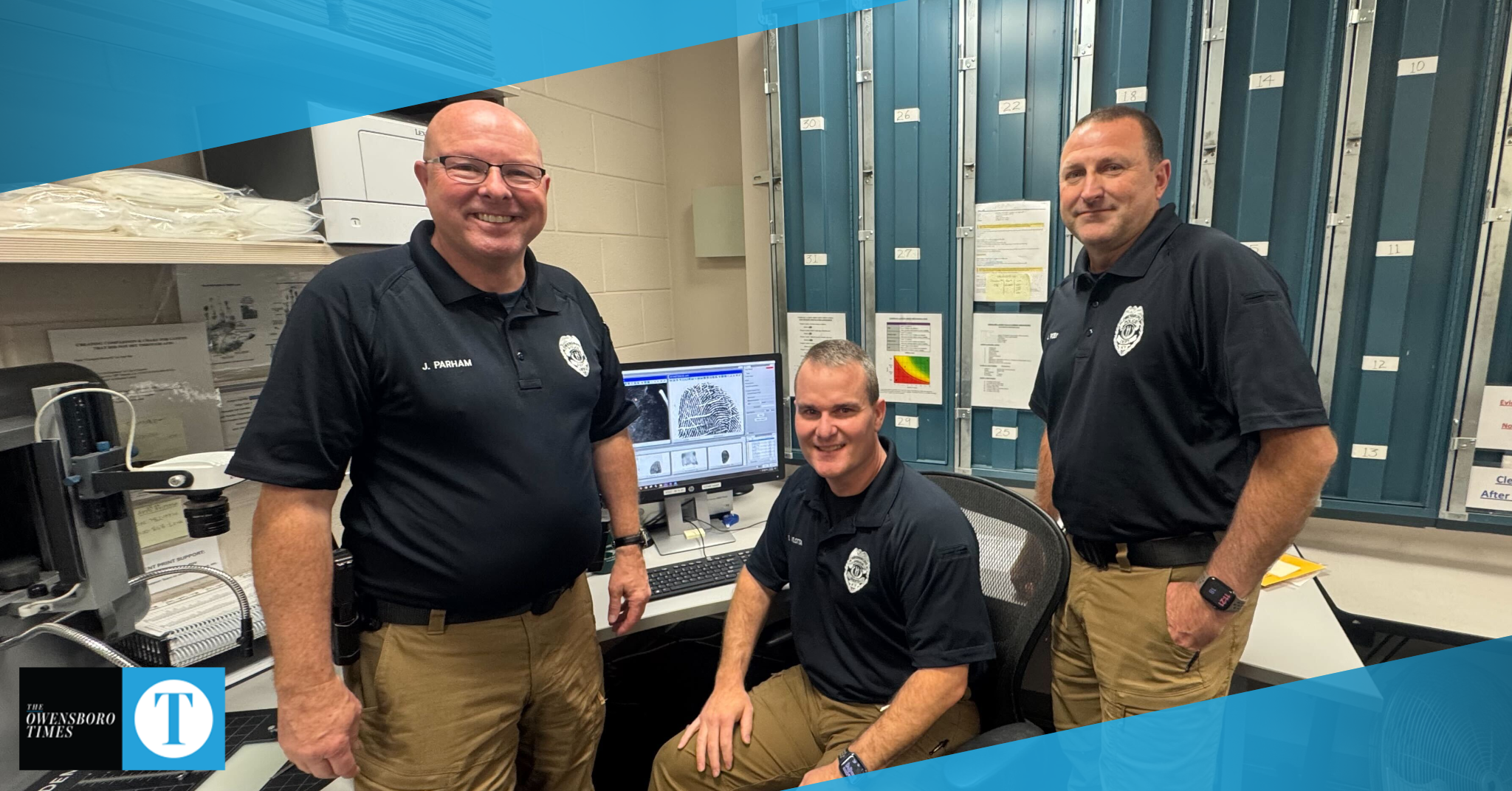
The Owensboro Police Department now operates one of the most advanced fingerprint labs in Kentucky — and one of only two accredited in the entire state — after the department’s Latent Fingerprint Laboratory officially earned national accreditation.
Officials said the accreditation from the American Association for Laboratory Accreditation (A2LA) highlights the lab’s commitment to quality and forensic excellence, an achievement that reflects years of investment and training. The lab handles approximately 500 fingerprint cases per year, providing crucial evidence in a wide range of criminal investigations.
“This accreditation is a big deal,” said Jim Parham, one of the department’s board-certified latent print examiners. “It reflects the professionalism, training, and scientific rigor that go into every print we examine.”
Before launching its own lab, OPD had to send fingerprint evidence to the Kentucky State Police laboratory, often waiting more than a year for results due to statewide backlogs. Now, with its in-house team and state-of-the-art equipment, OPD can deliver results in a matter of days or weeks, especially for serious or time-sensitive cases.
“If your car is broken into and we collect prints, it used to take 12 to 18 months just to find out if they were usable,” Parham said. “That’s a long time for someone to remain unidentified. Now, we can prioritize cases based on public safety and give detectives actionable leads much quicker.”
The lab’s formation was sparked by a fortunate encounter when a retired FBI and Secret Service fingerprint examiner moved back to Owensboro and offered to train the department. That began a multi-year process of specialized training, equipment purchases, and certification.
Parham and fellow examiner Jeff Roby are now the only two board-certified latent print examiners working within a local police department in Kentucky. Bryan Velotta, a third member of the forensic team, is fully trained and pursuing certification next.
To become board-certified, examiners must first be trained to competency, then spend at least a year gaining experience before sitting for a rigorous eight-hour exam. Accreditation, meanwhile, required a comprehensive review by A2LA, including the submission of detailed documentation and a two-day on-site inspection.
Though the lab is equipped with advanced tools like an Automated Fingerprint Identification System (AFIS), alternate light sources, dye stains, and forensic drying cabinets, the examiners emphasized that nothing replaces the human element in print analysis.
“People think it’s like CSI — plug a print into a computer and it tells you who it is,” Velotta said. “But it’s not that simple. A trained examiner has to identify unique characteristics, rule out distortions, and verify findings with a second examiner.”
Thanks to an $86,000 Homeland Security grant, the department secured the AFIS system, which allows OPD to search state and national databases for matches. Still, examiners must manually analyze prints, mark distinguishing features, and ensure results meet scientific standards before reporting identifications.
While the lab primarily supports OPD’s own investigations, it also assists other agencies on request — free of charge, based on workload and departmental approval.
“We’ve helped other departments with big cases when they reach out,” Parham said. “It’s not about getting paid. It’s about supporting justice and making our community safer.”
Parham noted that the lab’s existence is rare among local departments and only possible because of their unique situation.
“Without that retired examiner offering to train us, none of this would’ve happened,” he said. “Most departments simply can’t afford the training, the equipment, or the time it takes. We got lucky, and we ran with it.”
The department now maintains a rigorous chain of custody, handles evidence processing, and provides verified, court-admissible forensic fingerprint results locally.
“This is about doing the work the right way and doing it for the people of Owensboro,” Parham said.