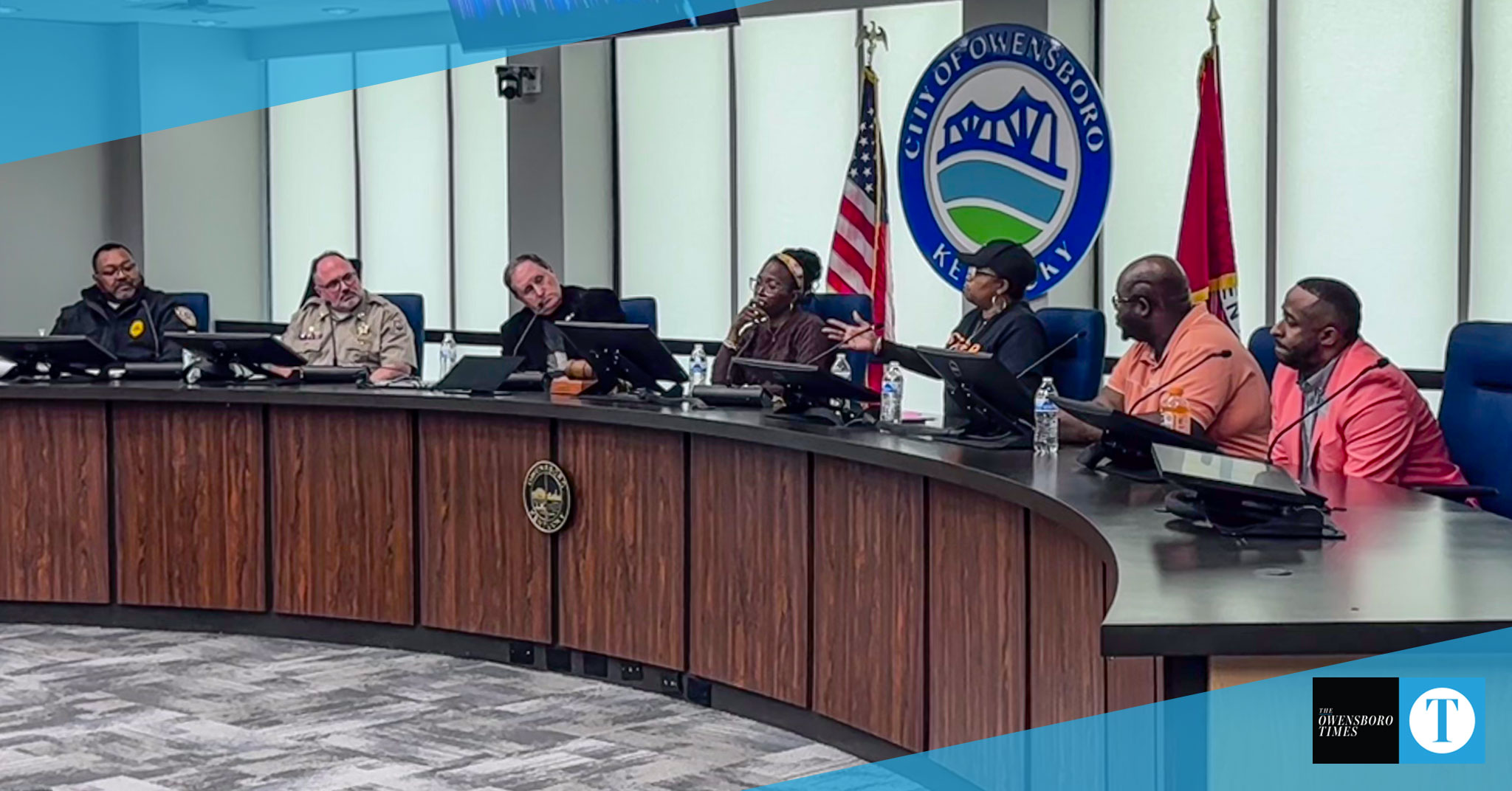
Community members, local officials, law enforcement, and program leaders shared a wide range of perspectives on youth gun violence during a public forum that lasted nearly two hours on Monday, with discussion focusing on causes, accountability, and possible solutions.
The event, hosted by the Owensboro Human Relations Commission, featured an hour-long panel followed by public comment, with approximately 50 people in attendance. The Rev. Rhondalyn Randolph, OHRC director and event moderator, said the goal was to move beyond statements and create a broader conversation.
“We do have a lot of programs that are taking place to try to reach at-risk youth … but it seems as if there are some kids that are like falling through the cracks,” Randolph said.
Panelists cite multiple contributing factors
Panelists repeatedly emphasized that there is no single cause or solution to youth gun violence.
“There is not one answer,” said DeMarcus Curry, founder of the Owensboro Youth Empowerment Summit. “No matter how hard, how much evidence you have, how much data you may collect, there is not one answer.”
Owensboro Police Chief Art Ealum pointed to both access to firearms and changes in behavior among young people.
“The weapons are readily available and through illegal means, often ill-gotten, where a gun owner doesn’t take responsibility for their weapon,” Ealum said. “They leave it in an unlocked vehicle. And these kids go out and car hop all the time. We’ve had more than five guns stolen out of one vehicle in this city, you know, which is absolutely insane.”
Ealum said those stolen weapons often end up in the hands of young people.
“So those guys hit the streets, and these kids get them,” he said.
Other panelists focused on family structure and whether young people feel supported. Allyson Sanders, who co-founded a mentorship program at Owensboro Middle School, said many students lack stability at home.
“So many of these kids don’t have the traditional mom, dad, even that aggressive grandma that’s at home,” Sanders said. “They don’t feel valued. So what is life to them? Nobody cares.”
Kelly Marshall, who lost her son to gun violence and has worked with at-risk youth, said individual decision-making also plays a role.
“At the end of the day, it’s choices,” Marshall said. “We put all these resources in front of them, we put all the tools in their hands, we’ve got programs like you said … but at the end of the day, it’s choices.”
Prevention and accountability discussed
Panelists differed at times on whether the issue should be addressed primarily through prevention efforts or stricter accountability.
Several stressed the need to begin intervention earlier. Sanders said current efforts often come too late.
“We need to start a kindergarten,” she said. “It needs to follow them, just like their curriculum … it’s necessary. It’s now about life or death.”
Bob Glenn, an Owensboro City Commissioner and retired educator, said structured activities can help keep young people engaged.
“The best way to avoid a child getting in trouble … is activities,” Glenn said, noting that he got heavily involved in extracurriculars at the elementary and middle school levels.
Curry said opportunities already exist in the community, but are not always utilized.
“What I see is that the youth are not participating,” Curry said. “What I see is the parents not making the youth participate.”
Travis Owsley, founder of Beverly’s Hearty Slice, spoke about the importance of building trust and consistency when working with young people, drawing from his own experiences growing up in the community.
“We gotta be consistent on what we’re doing… we gotta show up. We gotta go downtown… sit down and ask them, ‘What are you going through? How do you feel? We care. We love you,’” Owsley said.
Owsley said young people often respond to direct engagement and relationships, emphasizing that efforts to reach them must be ongoing rather than occasional.
Others pointed to a lack of consequences. Daviess County Sheriff’s Office Capt. Jeff Payne said accountability is a key issue.
“There is no quick fix to this,” Payne said. “My suggestion is some legislative overhaul involving the juvenile justice system, because there is zero accountability. … Until there’s some accountability involved … they do not care.”
Marshall echoed that sentiment.
“These kids these days have no fear,” she said. “They don’t fear anything.”
Law enforcement describes system challenges
Law enforcement officials said their ability to respond is shaped by existing laws and policies, particularly within the juvenile justice system.
“If the law says that we have to take this child to Warren County, we have to take them,” Payne said. “If the law says they can only be held for X amount of days, and then they’re returned home, we have to return them home.”
Ealum described challenges with monitoring and detention, including situations where tracking systems were not effectively enforced.
“We found out that they had an ankle monitor on, but there was nobody on the other end to monitor,” he said. “So they were just running around with some gaudy-looking jewelry on.”
Panelists also discussed the role of social media and technology. Payne said investigators often encounter online content connected to incidents.
“Pretty much every time we’ve had a violent crime … once we do search warrants … there they are posing with the guns,” Payne said.
He added that exposure to that content can influence behavior.
“These phones are becoming the parents,” Payne said.
Community input reflects additional perspectives
During the public comment portion, several attendees shared personal experiences and viewpoints, with speakers discussing topics such as trust — or lack thereof — in institutions, the role of adults, and broader cultural influences.
Some speakers emphasized the importance of mentorship and consistency in reaching young people, while others pointed to the impact of media, technology, and access to firearms. Policy-related questions were also raised, including concerns about recent legislation involving firearm access for younger adults.
Continued conversation encouraged
Throughout the forum, participants emphasized that addressing youth gun violence will require involvement from multiple parts of the community.
“We have to come together,” Randolph said. “It’s not going to be the police department, the school system, any individual program, or individual themselves that’s going to be the one to solve everything.”
The forum concluded with calls for continued discussion and engagement, with organizers indicating similar conversations could take place in the future as the community continues to seek solutions.