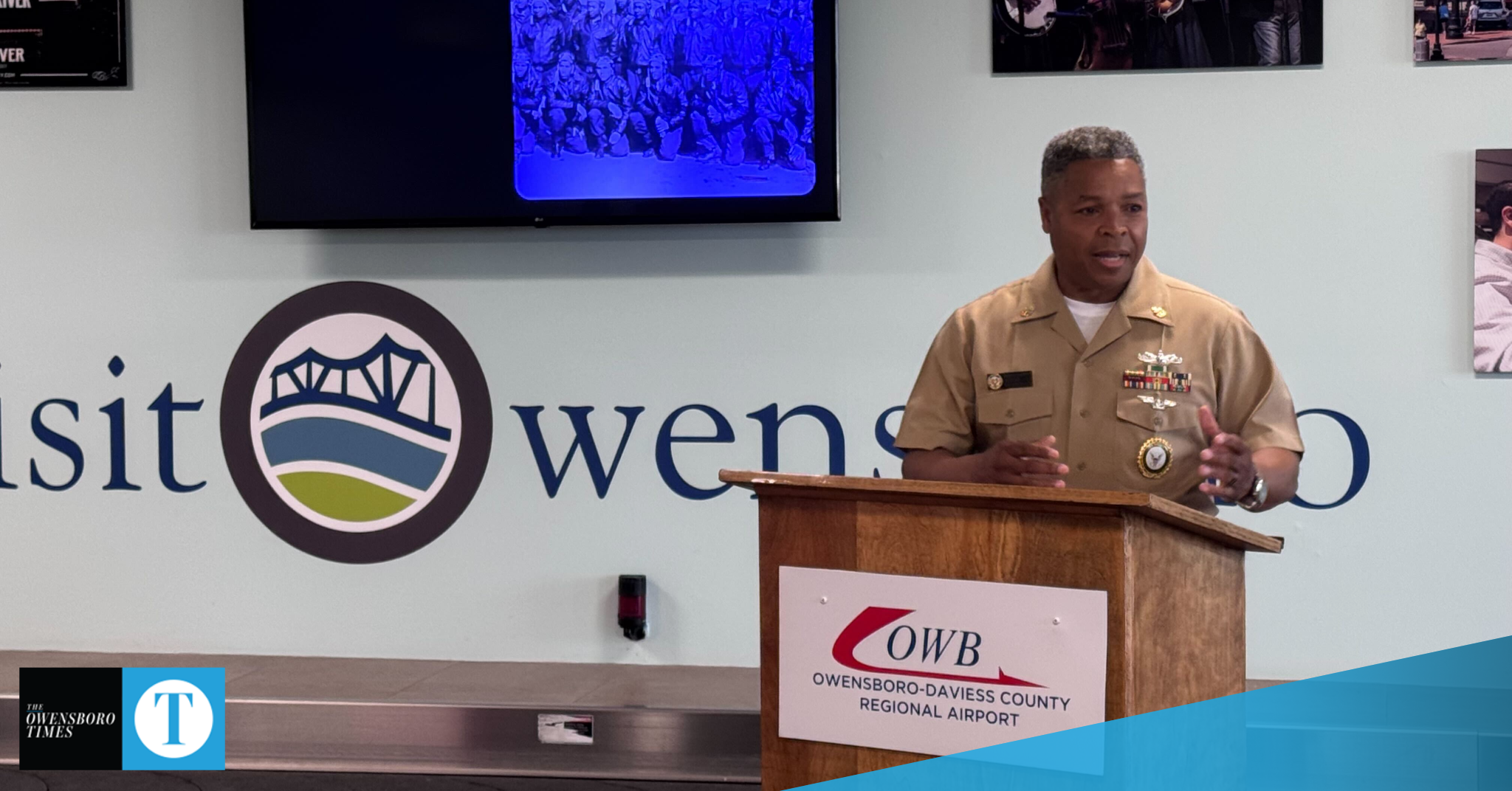
The legacy of the Tuskegee Airmen and their lasting impact on military service and civil rights were honored Thursday morning during a Tuskegee Airmen Commemoration Day program at the Owensboro-Daviess County Regional Airport.
Hosted by the Owensboro-Daviess County Veterans Organizations, the event brought together community members, veterans, and local leaders to reflect on the courage and achievements of the nation’s first Black military aviators during World War II.
Organizer Pamela Smith-Wright said the airport provided a meaningful backdrop for the ceremony, noting its connection to a local hero.
“Their courage, skill, and determination helped defend our nation while challenging barriers to segregation during World War II,” Smith-Wright said. “This location makes today especially meaningful. Here at the Owensboro-Daviess County Regional Airport, we are home to a permanent display honoring First Lieutenant Milton T. Hall, an Owensboro native and proud Tuskegee Airman.”
Smith-Wright said Hall’s legacy serves as a reminder that the history of the Tuskegee Airmen is deeply rooted in the local community.
“His legacy reminds us that this history is not distant. It lives right here in our community,” she said. “As we commemorate the Tuskegee Airmen today, may we reflect on their service, their sacrifice, and the lasting impact they continue to have on future generations.”
Daviess County Judge-Executive Charlie Castlen presented an official proclamation recognizing March 26, 2026, as Tuskegee Airmen Commemoration Day in Daviess County, highlighting the group’s historic contributions and the barriers they overcame.
“Whereas the outstanding performance and heroism of the Tuskegee Airmen was unprecedented in military aviation history and key to the United States’ air success in the European Theater during World War II,” Castlen said while reading the proclamation.
The proclamation also recognized March as a significant month in the history of the Tuskegee Airmen, marking milestones such as the graduation of the first cadets, the activation of early squadrons, and the awarding of the Congressional Gold Medal decades later.
Retired U.S. Navy Chief Petty Officer Michael Johnson, an Owensboro native, delivered the keynote address, connecting the Airmen’s legacy to his own military journey and highlighting the role of Tuskegee Airmen leader Lt. Gen. Benjamin O. Davis Jr.
Johnson said Davis’ career exemplified perseverance in the face of discrimination and helped open doors for future generations of service members.
“David spent more than 35 years in the military, breaking barriers at every level,” Johnson said. “He served all over the world, fighting against segregation on and off the battlefield. His service showed that Black soldiers were just as brave and capable as white soldiers.”
Johnson outlined Davis’ path from West Point to commanding the Tuskegee Airmen, noting the adversity he faced as one of the few Black officers in the military at the time.
“During his four years at the academy, he never had a roommate, ate his meals in silence, and was only spoken to if needed,” Johnson said.
Despite those challenges, Johnson said Davis went on to lead the 99th Fighter Squadron and later the 332nd Fighter Group, helping build an extraordinary combat record in Europe.
“In the two years Davis commanded the Tuskegee Airmen, they amassed an impressive record,” Johnson said. “They downed more than twice the number of aircraft they lost and never lost a bomber on an escort mission.”
Johnson said those accomplishments forced the military to reconsider long-held assumptions about race and capability.
“With their outstanding service record, the military could no longer use the excuse that Black soldiers were inferior in battle or unfit to lead,” he said.
Drawing a personal connection, Johnson said the Airmen’s achievements directly shaped his own career.
“But the Tuskegee Airmen and what they accomplished, they paved the way for somebody like me to make chief,” Johnson said. “Because had they not done what they did, I wouldn’t have made the rank.”
Johnson also emphasized Davis’ continued influence after World War II, including his role in integrating the U.S. Air Force and mentoring future leaders.
“Davis helped integrate the Air Force, serving as the service’s first Black general and opening up opportunities for African Americans to follow in his footsteps,” Johnson said.
Throughout the program, Johnson emphasized the Airmen’s perseverance in the face of segregation and discrimination, as well as their excellence in combat and training, which helped reshape the U.S. military.
The event concluded with an invitation for attendees to visit the permanent display honoring Lt. Milton T. Hall inside the airport, offering a closer look at Owensboro’s connection to the Tuskegee Airmen.
Organizers said the annual commemoration serves not only as a tribute to the past but also as a reminder of the progress made and the responsibility to carry that legacy forward for future generations.