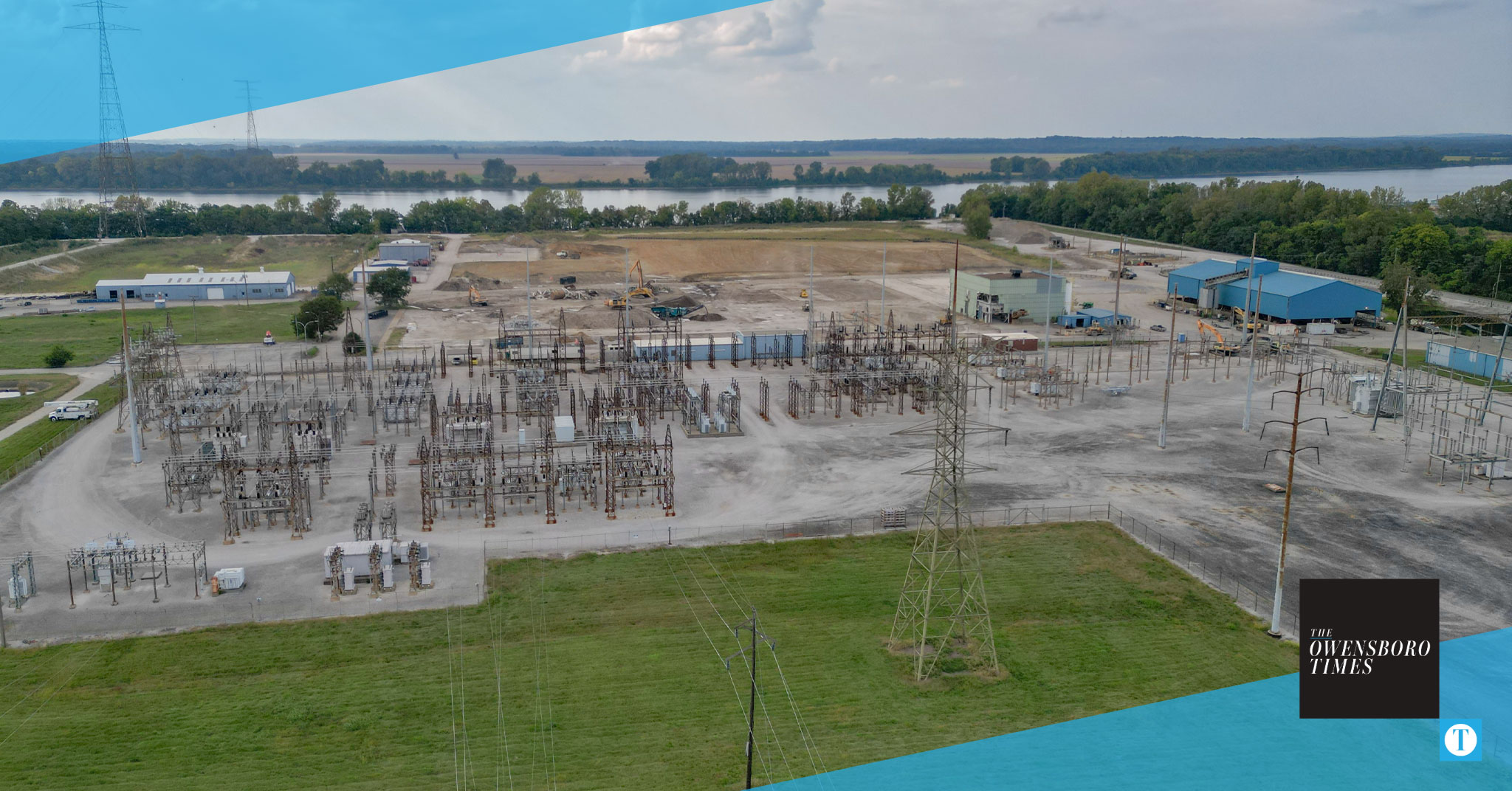
Owensboro Municipal Utilities is exploring the possibility of bringing large-scale power generation back to the former Elmer Smith Station site, announcing plans to study a proposed 545-megawatt natural gas-fired power plant that could be built along the Ohio River.
OMU General Manager Tim Lyons updated the Owensboro Board of Commissioners on Tuesday, outlining the utility’s efforts to evaluate future power supply options as it prepares to transition into the Midcontinent Independent System Operator (MISO) market in 2027.
The proposal centers on approximately 30 acres at the former Elmer Smith Station property, where Green River East GenCo LLC has submitted a generator interconnection application for a natural gas-fired facility capable of producing about 545 megawatts of electricity.
Lyons emphasized that the project remains in the early stages and is far from guaranteed.
“The goal has always been to try to find generation or develop generation for this property,” Lyons said.
The OMU Commission previously approved an option-to-lease agreement with Green River East GenCo for the site, allowing the company to conduct surveys and technical studies needed to determine whether the project is feasible.
OMU has hired GDS Associates to conduct a generator interconnection study, a process expected to take at least six months. The study will evaluate how the proposed plant would affect OMU’s system and neighboring electric grids while ensuring compliance with federal reliability standards. Lyons said the cost of those studies will be borne by the developer, not OMU ratepayers.
The announcement marks the latest chapter in OMU’s long history of electric generation.
Lyons noted that Owensboro’s municipal electric system first began delivering power on Dec. 31, 1900. The city later combined its electric and water systems to form modern-day OMU in 1940 before expanding generation with the Elmer Smith Station, whose first unit entered service in 1964 and second unit followed in 1974. At its peak, the coal-fired station generated 415 megawatts of electricity.
That era ended in May 2020 when Elmer Smith produced its final megawatt of electricity. OMU later completed demolition of the facility and environmental remediation work required by the Environmental Protection Agency. Groundwater monitoring continues at former ash pond locations that have since been repurposed for water treatment operations.
Following the plant’s closure, OMU conducted an Integrated Resource Plan in 2022 to evaluate future energy needs. Lyons said the utility examined constructing its own 150-megawatt natural gas facility but determined the project was not economically feasible because OMU’s size did not provide sufficient economies of scale.
Instead, OMU spent the last four years discussing potential generation opportunities with developers and energy companies while simultaneously pursuing a new power supply strategy.
Last year, OMU announced plans to leave its current power supply arrangement and join MISO in 2027. The utility also signed a long-term power supply agreement with NextEra Energy Marketing beginning in June 2027.
Lyons said having a large generating facility located in Owensboro could provide long-term benefits, including increased reliability, economic development opportunities, lease revenue for OMU and additional power supply options. However, he cautioned that OMU is not currently considering ownership of the proposed plant.
A facility of that size would likely cost around $1 billion to construct, he said.
“Taking on a plant of a billion dollars would put a considerable risk upon OMU customers,” Lyons said.
Instead, OMU would likely explore options such as power purchase agreements or limited participation if the project advances.
Commissioners also asked about potential employment impacts. Lyons estimated a plant of that size could employ between 15 and 20 workers if operated locally, though staffing would depend on the eventual ownership and operating structure.
Commissioner Jeff Sanford asked about water consumption. Lyons said a modern natural gas plant would use significantly less water than the former coal-fired facility because it would likely rely on a closed-loop cooling system. He estimated water usage at roughly 50,000 gallons per day.
Commissioner Bob Glenn asked whether a new generating facility could help stabilize future electric rates.
Lyons said rising costs across the power industry make lower rates unlikely.
“I do not see energy prices reducing anytime soon,” Lyons said. “I think the best thing is to mitigate them and have them reasonably increase over time.”
He noted that construction costs for large power plants have more than doubled in recent years due to inflation, supply chain challenges and increasing demand for generation equipment.
If studies determine the project is viable, Lyons said OMU hopes to complete the evaluation before its transition into MISO, potentially giving the developer greater flexibility to market power throughout the regional grid.
For now, he said, the focus remains on determining whether the project can move forward.