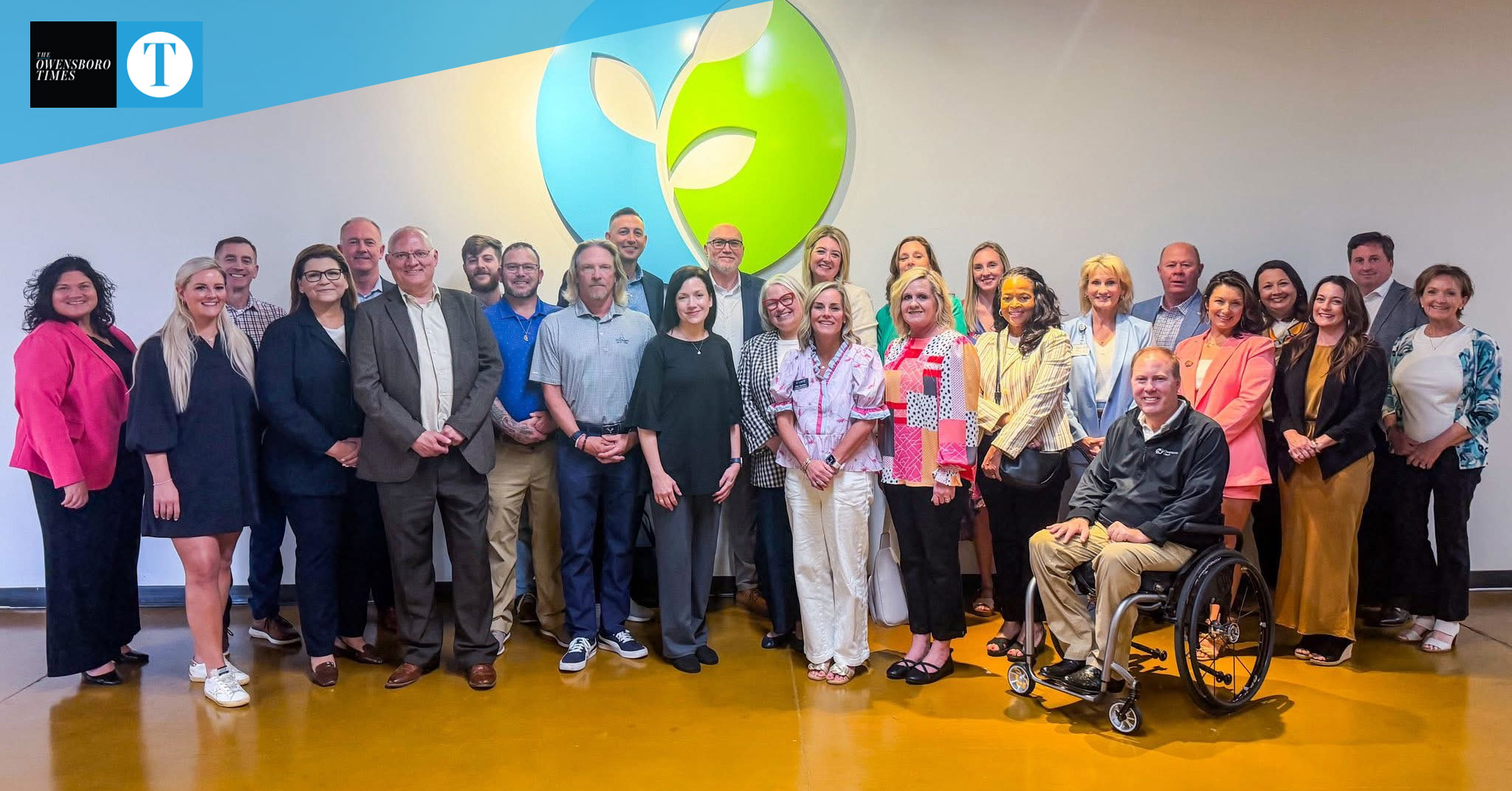
Community leaders who traveled to Northern Kentucky last month to tour the Life Learning Center said the experience reinforced both the strengths already present in Owensboro-Daviess County and the need for stronger coordination among agencies tackling addiction, mental health, and workforce challenges.
More than a dozen local stakeholders participated in the visit organized by the Owensboro-Daviess County Drug Free Alliance Steering Committee and Daviess County Judge-Executive Charlie Castlen. The group toured the Covington-based center, which combines recovery support, workforce development, behavioral health services, and life-skills training under one roof.
Following the trip, attendees submitted written reflections outlining what stood out most, what felt most applicable to Owensboro-Daviess County, and what concerns remain moving forward.
A common theme among participants was that Owensboro already has many of the services needed to support individuals in recovery, but those resources are often scattered across multiple organizations rather than coordinated through a centralized system.
“The collaborative model feels especially relevant,” said Clay Horton of the Green River District Health Department. “Our community already has many strong organizations, and the potential to align services more intentionally in one place could create meaningful impact.”
Several attendees highlighted the center’s focus on long-term stability through education, employment, and life-skills training rather than only short-term treatment.
Rebecca Horn of the Green River District Health Department said the center’s gradual “build-up over several weeks” helps clients obtain meaningful employment while rebuilding confidence and stability. She noted that the self-referral process also allows people to seek help before reaching a crisis point.
Others pointed to the center’s measurable outcomes, including a reported recidivism rate of 3.8%.
Samantha Taylor-Kaai of Audubon Area Community Services called that figure “a strong indicator of the model’s effectiveness,” while also praising the integration of workforce development and economic mobility into the recovery process.
Blake Templeton of TrueNorth said one of the biggest takeaways was how seamlessly multiple services were delivered in one location.
“The biggest takeaway for me is the power of centralization paired with workforce development,” Templeton said. “In Owensboro, we already have many strong organizations doing great work, but services are often spread out, making it difficult for individuals to navigate resources.”
Chris Seaton of Rooted Recovery said the model could potentially help address several issues facing the region simultaneously, including addiction recovery, homelessness, and recidivism.
“We must give these people something to look forward to and help them be self-sufficient,” Seaton said. “Realistically, most jobs they qualify for won’t help them live a quality of life that is sustainable.”
While many attendees expressed optimism, several also cautioned that creating a similar model locally would require careful planning, long-term funding, and broad community buy-in.
Debbie Zuerner of Owensboro Health said many entities would need to be “all in” for such a system to work effectively in Daviess County.
Others raised questions about sustainability once opioid settlement funds are exhausted, as well as how any future initiative could avoid duplicating services already offered locally.
“I think the opportunity lies in building something that unifies and strengthens existing efforts,” Templeton said.
Brooke Arnold, director of RiverValley Behavioral Health’s Regional Prevention Center, said the trip was encouraging because of the number of local stakeholders who participated together. However, she also questioned whether the Covington model’s curriculum had been studied long-term and stressed the importance of addressing prevention efforts for children and future generations.
Dr. Wanda Figueroa-Peralta of RiverValley Behavioral Health echoed the need for careful evaluation before adopting any specific model or curriculum.
“I keep coming back to how we do this in a way that strengthens collaboration locally,” she said. “We have a lot of good work and talent already in place, and I’d hate for us to unintentionally overlook that.”
Multiple attendees emphasized that the trip itself may have been valuable simply because it brought together representatives from organizations that do not always collaborate closely.
Stacy Edds-Ellis of GOLI said the visit demonstrated the importance of partnerships and “staying in their respective lanes” while working toward a common goal.
Joey Ryan of Same Pages Mission said the next step will be determining whether local organizations can capitalize on the momentum generated by the trip.
“My biggest concern with this trip is the follow-up,” Ryan said. “I believe we need to bring everyone together immediately, strike while the iron is hot.”
Castlen previously told the Owensboro Times that his hope was for local leaders to leave the visit energized and begin exploring how a collaborative, evidence-based model could eventually be adapted for Owensboro-Daviess County.
The trip came as local officials continue weighing how to use opioid settlement dollars distributed through nationwide litigation involving pharmaceutical companies. According to coalition leaders, Daviess County has accumulated more than $1 million in opioid settlement funds, while the City of Owensboro has also received several hundred thousand dollars.