This article is sponsored by Bruner’s Coin Shop.
For more than 60 years, Bruner’s Coin Shop has helped generations of collectors buy, sell, and learn about coins, currency, and precious metals, growing from a tiny partition inside an antique store into one of the region’s longest-running family businesses.
Founded in 1964 by Darrell and Shirley Bruner, the business began in about 250 square feet inside Rex Bruner’s antique store at 15th and Breckenridge streets. The original shop featured a single display counter and enough room for only a handful of customers. Two of the display cases from those early days remain in use today.
Since then, the shop has relocated several times, operating on 15th Street, Lewis Street (now J.R. Miller Boulevard), Triplett Street, and its current home on Washington Avenue.
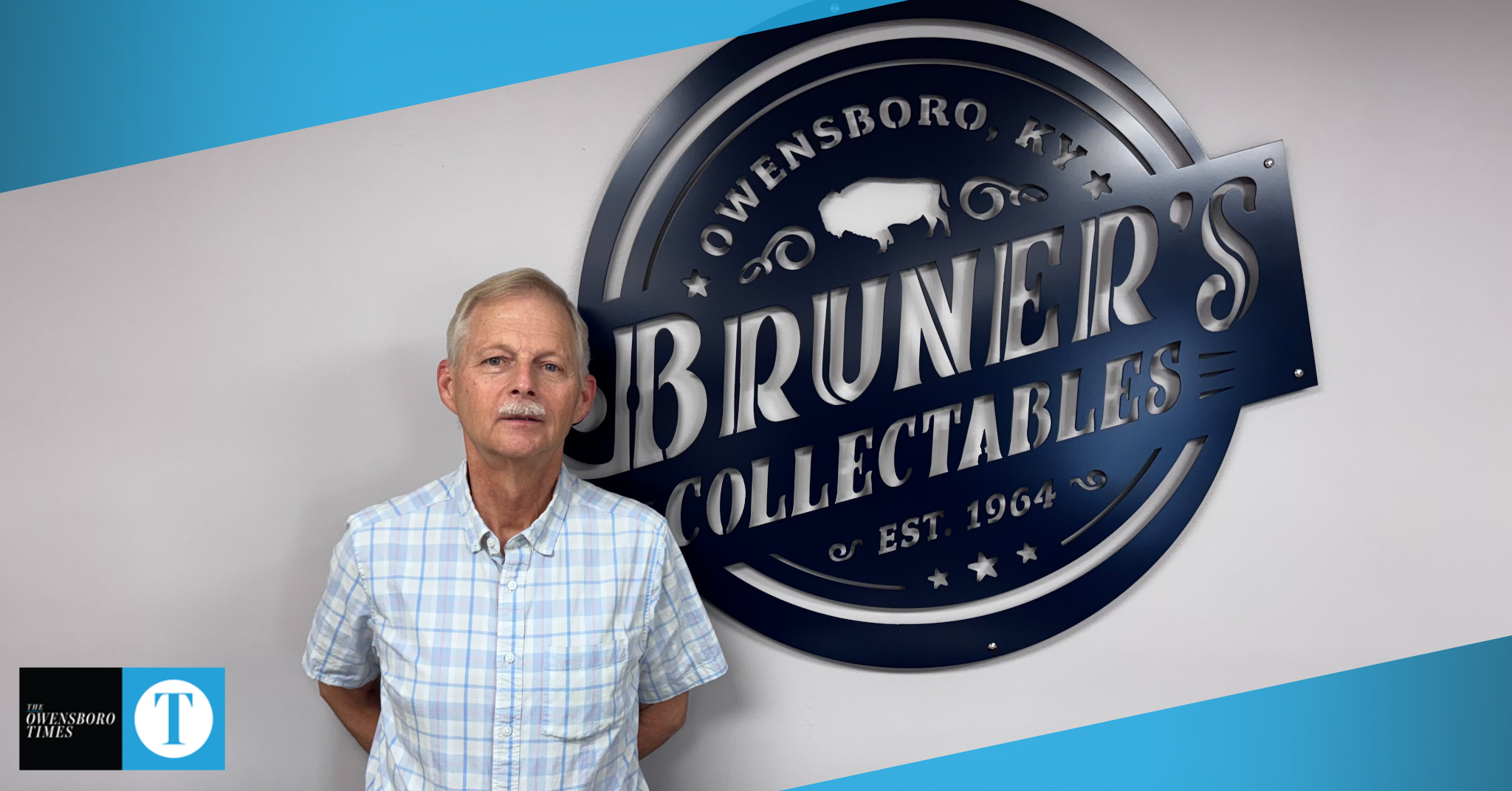
Today, the business remains firmly rooted in family. Kevin Bruner, who purchased the shop from his father after Darrell Bruner retired at age 88, has been part of the business since childhood.
“We’ve been here since I was born, except for the time I went off to college,” Bruner said. “It’s always been a part of me.”
The family tradition now spans four generations. Along the way, parents, siblings, cousins, nieces, neighbors, and other relatives have worked in the business. Today, Bruner’s wife, son Kyle, and 7-year-old grandson are among those helping continue the legacy, along with four employees.
Bruner said one of the unique aspects of operating a coin shop is becoming familiar with customers who often prefer to remain anonymous.
“A lot of our customers don’t really introduce themselves because they don’t really want the word to get out about what they do as far as being a collector for security reasons,” he said.
The shop specializes in U.S. coins, paper currency, gold and silver bullion, appraisals, and special orders. It also maintains a “want list,” allowing collectors to request specific coins or currency that staff can often locate through an extensive dealer network.
That network has become increasingly important as technology has transformed the coin industry.
When the business opened, prices were tracked through printed monthly guides, appraisals were handwritten, and calculations were completed using hand-crank adding machines.
“Everything he did was by hand,” Bruner said of his father. “To get current prices on coins, you had to wait until the next monthly edition of the price guide came out.”
Today, live market prices for gold and silver are available instantly online, allowing dealers to react as precious metal values fluctuate throughout the day.
“It’s kind of like watching the stock market,” Bruner said. “It goes up and down all day long.”
Marketing has changed just as dramatically.
Where Darrell Bruner once relied on newspaper advertisements and Yellow Pages listings, today’s business reaches customers through social media, online sales, and collector networks across the country.
Those digital connections proved invaluable during the COVID-19 pandemic.
Although the storefront closed temporarily, the business continued operating by shipping hundreds of orders throughout the United States and Puerto Rico.
“I would do online sales during the day, go into the shop at night to fill the orders, then take them to the post office the next day,” Bruner said.
Online business continues to be an important part of the operation.
Despite advances in technology, Bruner believes the appeal of coin collecting remains rooted in history.
“I explain it to people that we’re selling tiny pieces of art on a round piece of metal,” he said. “These coins are artwork. They’re storytellers. You can learn a lot about history with coins.”
Interest in collecting has increased recently as the U.S. Mint releases commemorative coins celebrating the nation’s 250th anniversary.
Bruner said the limited-edition designs, which include redesigned circulating coins and commemorative issues, have generated strong demand among collectors.
“They sell faster than we can get them,” he said.
Although recent announcements about ending production of the cent have prompted questions from customers, Bruner said most modern cents are too common to justify stockpiling.
“There were something like 450 billion made,” he said. “We’re not recommending that you hoard them. Use them. We tell people to spend them before inflation does.”
More than six decades after opening in a small corner of an antique store, Bruner said the business remains focused on the relationships it has built with collectors throughout the Owensboro area and beyond.
“It’s always been a part of me,” he said. “And it’s always been a part of this community.”